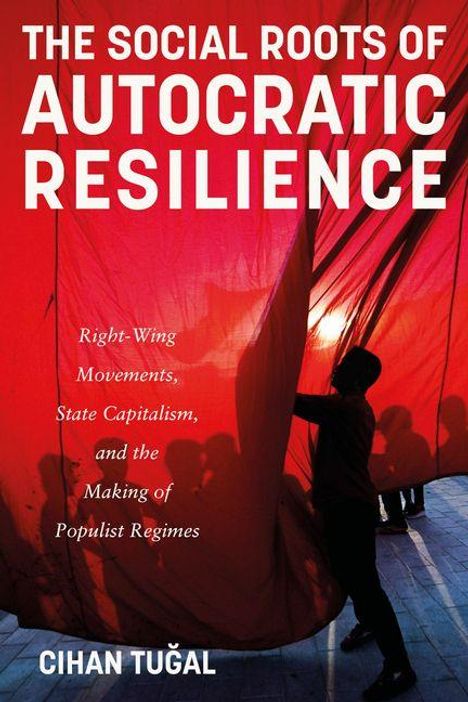
Tu&: The Social Roots of Autocratic Resilience, Kartoniert / Broschiert
The Social Roots of Autocratic Resilience
- Right-Wing Movements, State Capitalism, and the Making of Populist Regimes
Lassen Sie sich über unseren eCourier benachrichtigen, sobald das Produkt bestellt werden kann.
- Verlag:
- Stanford University Press, 07/2027
- Einband:
- Kartoniert / Broschiert
- Sprache:
- Englisch
- ISBN-13:
- 9781503650404
- Umfang:
- 368 Seiten
- Erscheinungstermin:
- 6.7.2027
- Hinweis
-
Achtung: Artikel ist nicht in deutscher Sprache!
Weitere Ausgaben von The Social Roots of Autocratic Resilience |
Preis |
|---|---|
| Buch, Gebunden, Englisch | EUR 166,08* |
Ähnliche Artikel


Klappentext
The rise of strongman rule within electorally competitive systems is increasingly shaping 21st-century politics and society. While some such autocratic administrations prove short-lived and fail to induce significant social transformation, others demonstrate greater resilience and achieve profound societal impact. This raises a crucial question: what differentiates the more durable autocracies of our era? Cihan Tuğal examines right-wing authoritarianism, market economics, and populism in countries outside the core advanced capitalist world, including Turkey, Hungary, Poland, and India. Market reforms have intensified not only inequality and exclusion, but disorganization throughout the world. Authoritarian leaders have successfully appealed to disorganized people's sense of exclusion, initially channeling their anger towards minorities, foreigners, and ill-defined 'elites,' leaving pro-market policies mostly untouched. However, in electorally competitive systems, only authoritarian leaders who facilitated mass reorganization, derailed market policies, or resorted to state capitalism have had staying power. Even though strongmen's displays of masculinity and undermining of institutions provided further fuel for this process, they were not its primary movers. Tuğal offers a definitive statement on the interplay between populism, autocracy, and mass organization, while assessing the future prospects for democracy both in the countries under scrutiny and more broadly, in places such as Brazil and the United States.