Transformational Participatory Urbanism, Gebunden
Transformational Participatory Urbanism
- Making Do as a Spatial Practice
(soweit verfügbar beim Lieferanten)
- Herausgeber:
- Liska Chan, Elizabeth Stapleton
- Verlag:
- Taylor & Francis Ltd (Sales), 04/2026
- Einband:
- Gebunden
- Sprache:
- Englisch
- ISBN-13:
- 9789463725484
- Artikelnummer:
- 12530970
- Umfang:
- 250 Seiten
- Gewicht:
- 548 g
- Maße:
- 234 x 156 mm
- Stärke:
- 16 mm
- Erscheinungstermin:
- 16.4.2026
- Hinweis
-
Achtung: Artikel ist nicht in deutscher Sprache!
Klappentext
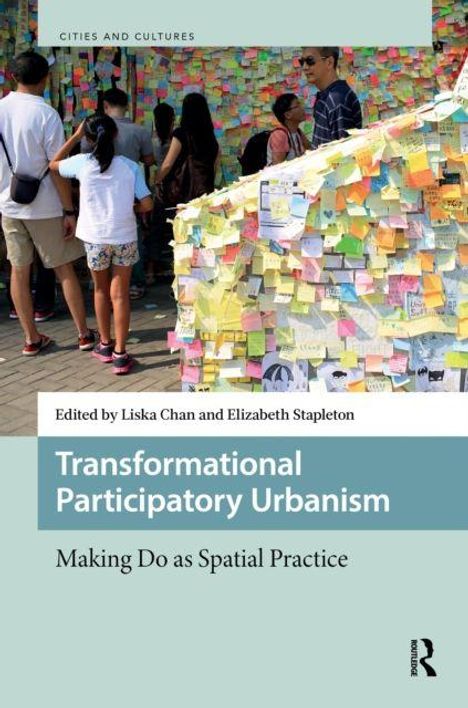
Transformational Participatory Urbanismexplores making do as a critical spatial practice at the intersection of spatial justice and creative geography. Through cases from Hong Kong's Lennon Walls and San Francisco Bay mudflats to containerbased sanitation in Haiti and Toronto's strip mall parking lots, contributors show how people rework urban space under constraint-through adaptation, care, and resistance. Grounded in de Certeau, Levi-Strauss, Soja, and Haraway, the volume frames making do as urban bricolage: Materially inventive, politically assertive, and speculative about more just futures.
Organised in three parts-Discourse, Process, and Engagement-the book ranges from theory to field practice. Essays examine self-build housing manuals in Mexico, tactics of market curation and participation, artistic interventions in Chinatown, gardening as reparative practice, mud and ruins as co-authors of landscape, sidewalk vernaculars, and maintenance as creative care. Engagement chapters consider sanitation knowledge transfer in Haiti, solidarity clinics in Athens, civic commons on private parking lots (plazaPOPS), and Taipei's Nanji Rice as commoning infrastructure. Together, these chapters foreground situated knowledge, minor tactics, and claims to spatial agency.
This book is written for scholars, practitioners, and advanced students in landscape architecture, urban design and planning, architecture, geography, and visual culture as well as civic leaders, nongovernmental organisations, and community organisers seeking low-cost, high-impact approaches to equitable placemaking.