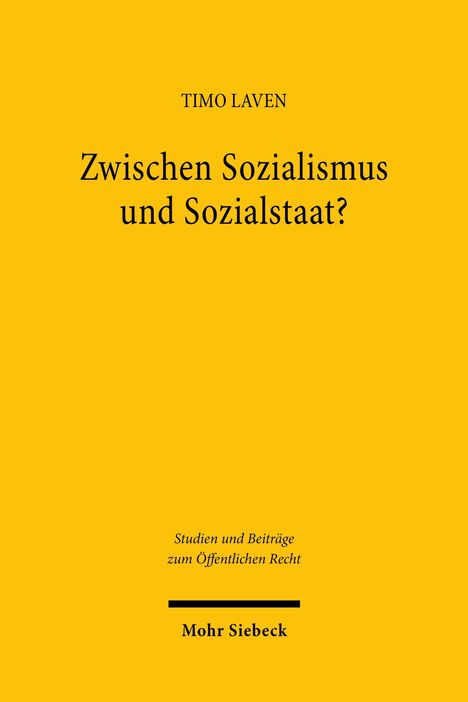
Timo Laven: Zwischen Sozialismus und Sozialstaat?, Kartoniert / Broschiert
Zwischen Sozialismus und Sozialstaat?
- Art. 15 GG in der Staatsrechtslehre des 20. Jahrhunderts
Sie können den Titel schon jetzt bestellen. Versand an Sie erfolgt gleich nach Verfügbarkeit.
- Verlag:
- Mohr Siebeck GmbH & Co. K, 03/2027
- Einband:
- Kartoniert / Broschiert
- Sprache:
- Deutsch
- ISBN-13:
- 9783162010339
- Artikelnummer:
- 12921503
- Umfang:
- 470 Seiten
- Nummer der Auflage:
- 27001
- Ausgabe:
- 1. Auflage
- Erscheinungstermin:
- 31.3.2027
- Serie:
- Studien und Beiträge zum Öffentlichen Recht
Klappentext
The question of ownership has returned with new urgency, most visibly in the Berlin referendum on the socialization of large housing portfolios. At the center of the debate is Article 15 of the Basic Law, a provision that has never been applied since 1949. Yet the precise meaning of its authorization to transfer land, natural resources, and means of production into public ownership remains unresolved and historically contested. At the same time, the provision embodies the possibility of a fundamentally different economic order and thus raises far-reaching questions about our understanding of the constitution. The polarized debate either relegates Article 15 to the status of a "constitutional fossil" or regards it as an instrument of democratic transformation.
Timo Laven provides the first systematic account of the eventful yet largely forgotten history of the socialization clause. The first part places Article 15 within its intellectual-historical context from the mid-nineteenth century onward, revealing it as a product of political conflicts and legislative experimentation during the Weimar Republic. The period following the Second World War presents a more nuanced picture that challenges the conventional narrative surrounding the political circumstances of 1949. The second main part reconstructs, for the first time, the constitutional-law debate since the provision entered into force and demonstrates that Article 15 was initially understood as a serious component of Germany's economic constitution. Its later marginalization, by contrast, resulted from political choices and methodological shifts in fundamental rights doctrine.
This historical perspective helps explain today's polarization, calls presumed constitutional limits into question, and opens space for an informed and forward-looking discussion about property, the common good, and democratic self-government.
Anmerkungen:
Bitte beachten Sie, dass auch wir der Preisbindung unterliegen und kurzfristige Preiserhöhungen oder -senkungen an Sie weitergeben müssen.
Mehr von Studien und Bei...
-
Henning SchaafDie Grundrechtswirkung auf das PrivatrechtsverhältnisBuchAktueller Preis: EUR 129,00
-
Carla Elisabeth HackInnerstaatliche Subjektivierung von staatsgerichtetem VölkerrechtBuchAktueller Preis: EUR 89,00
-
Luisa LehningMehrdimensionale DiskriminierungenBuchAktueller Preis: EUR 89,00
-
Maximilian PetrasVernetzte AutonomieBuchAktueller Preis: EUR 84,00