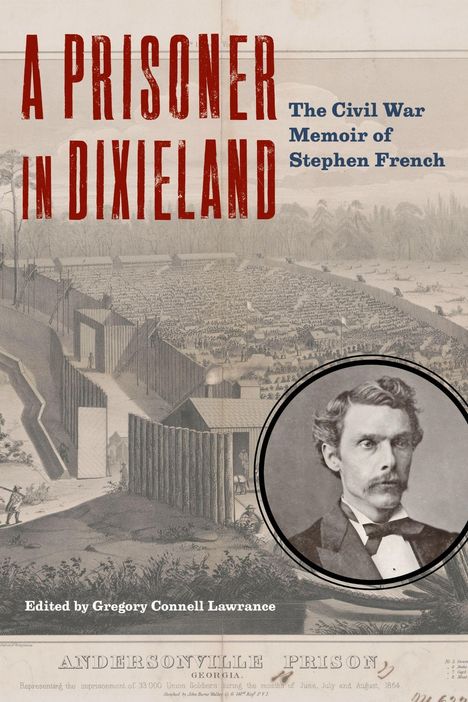
Stephen French: A Prisoner in Dixieland, Gebunden
A Prisoner in Dixieland
- The Civil War Memoir of Stephen French

Sie können den Titel schon jetzt bestellen. Versand an Sie erfolgt gleich nach Verfügbarkeit.
- Herausgeber:
- Gregory Connell Lawrance
- Verlag:
- Potomac Books, 02/2027
- Einband:
- Gebunden
- Sprache:
- Englisch
- ISBN-13:
- 9781640127098
- Artikelnummer:
- 12619264
- Umfang:
- 208 Seiten
- Erscheinungstermin:
- 1.2.2027
- Hinweis
-
Achtung: Artikel ist nicht in deutscher Sprache!
Klappentext
A Prisoner in Dixieland reconstructs the complete Civil War experience of Union soldier Stephen French, offering a rare and unvarnished view of the daily realities of wartime service. French's memoir charts his full trajectory--from his enlistment as a teenage volunteer in 1862 through battlefield engagements, capture, escape, recapture, and eventual release.
At the heart of French's journey is Andersonville--Camp Sumter--the most infamous Confederate prison and one of the darkest monuments to the war's moral breakdown. French endured its horrors twice, yet managed to leave a record that is neither lurid nor exaggerated. He catalogs five days of wandering through Georgia's swamps and forests as an escapee, enduring starvation, disease, and betrayal. But French also gestures toward acts of humanity: a stranger sharing cornbread, a word of encouragement from a fellow inmate, the silent dignity of those who chose to endure rather than succumb.
A Prisoner in Dixieland is not simply a war memoir, it is a meditation on survival, the frailty of institutions, and the power of memory. French's return home was not the end of his journey--he lived for sixty-three more years, shaped by the choices he made, the horrors he endured, and the truths he felt compelled to preserve. His is a voice not of myth but of presence. And in that presence, we are reminded that history is not always made by the mighty--but often by those who, when tested, endure.
This volume draws from three iterations of French's story--an 1866 manuscript written shortly after his parole, an 1886 transcription, and a fuller 1910 reflection written at the end of his life. The editor's foreword and annotations contextualize how French's narrative evolved over time.