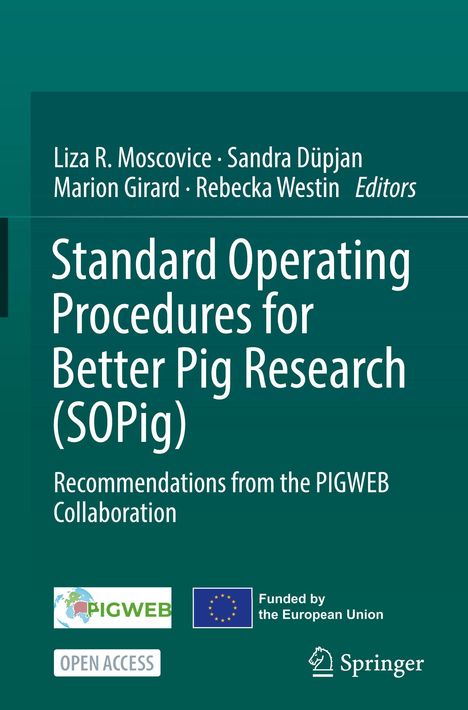
Standard Operating Procedures for Better Pig Research (SOPig), Gebunden
Standard Operating Procedures for Better Pig Research (SOPig)
- Recommendations from the PIGWEB Collaboration
(soweit verfügbar beim Lieferanten)
- Herausgeber:
- Liza R. Moscovice, Sandra Düpjan, Marion Girard, Rebecka Westin
- Verlag:
- Springer, 06/2026
- Einband:
- Gebunden
- Sprache:
- Englisch
- ISBN-13:
- 9783032248985
- Artikelnummer:
- 12831037
- Umfang:
- 184 Seiten
- Gewicht:
- 446 g
- Maße:
- 241 x 160 mm
- Stärke:
- 16 mm
- Erscheinungstermin:
- 24.6.2026
- Hinweis
-
Achtung: Artikel ist nicht in deutscher Sprache!
Klappentext
Pig research is facing a growing demand for robust, reproducible, and welfare-conscious data, which promotes increases in collaboration among researchers worldwide to improve research quality. At the heart of this effort lies standardisation---ensuring that experimental procedures are consistent, transparent, and aligned with best practices.
This Open Access book presents the outcome of a major initiative within the EU Horizon 2020 PIGWEB project, where multiple experts working at institutions throughout Europe collaborated on a set of Standard Operating Procedures (SOPs) for commonly used methods in pig research. Each SOP is a step-by-step guide, detailing recommended materials, equipment, and procedures, while emphasising refinements and non-invasive alternatives in line with the 3R principles of Replacement, Reduction and Refinement.
Covering a wide range of disciplines in animal science, the book includes protocols for:
- Blood, urine and saliva sampling for metabolic and hormonal analysis
- Faeces collection for digestibility studies
- Thermographic and spectroscopic methods for physiological assessments
- Imaging techniques for determining body and carcass composition
With its easy-to-follow format, comprehensive illustrations, example data collection and analysis spreadsheets and practical recommendations, this book serves as both a learning resource and a reference tool for researchers, technicians, and students. By promoting harmonised procedures across facilities, it supports data comparability, animal welfare, and the advancement of pig research globally. Whether setting up a new experiment or striving for reproducibility in collaborative projects, this book is an essential guide to standardised, ethical, and innovative pig research.