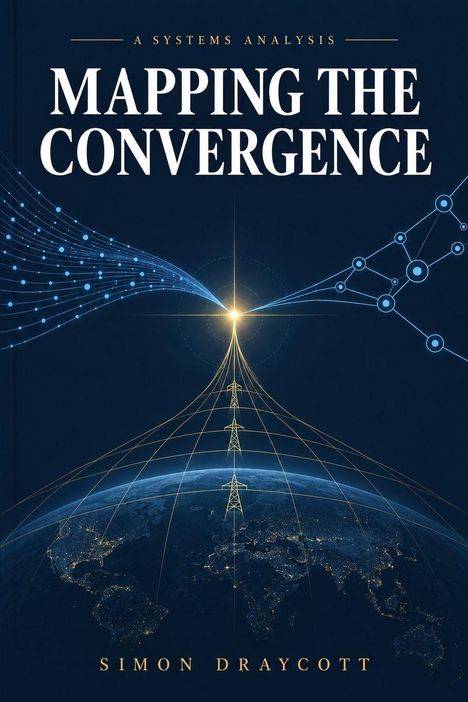
Simon Draycott: Mapping The Convergence, Kartoniert / Broschiert
Mapping The Convergence
(soweit verfügbar beim Lieferanten)
- Verlag:
- Simon Draycott, 09/2026
- Einband:
- Kartoniert / Broschiert
- Sprache:
- Englisch
- ISBN-13:
- 9783542340230
- Artikelnummer:
- 12950643
- Umfang:
- 118 Seiten
- Gewicht:
- 184 g
- Maße:
- 229 x 152 mm
- Stärke:
- 7 mm
- Erscheinungstermin:
- 30.9.2026
- Hinweis
-
Achtung: Artikel ist nicht in deutscher Sprache!
Klappentext
Artificial intelligence, robotics, and energy have stopped being three separate stories. They have become one interlocking system reshaping economic power, state power, and the global order.
Mapping the Convergence is a systems analyst's guide to the machinery behind the headlines: the chip supply chains, the grid bottlenecks, the capital flows, and the geopolitical maneuvering that connect a single AI training run to a natural gas turbine order, a semiconductor export control, and a labor market shift on the other side of the world. Written for readers who want the macro and geopolitical picture rather than personal advice or stock tips, this book builds a clear, evidence-based framework for reading a decade of accelerating change - without pretending to predict exactly how it ends.
What you'll gain:
- A structural understanding of why compute, energy, and robotics have become strategically coupled, and why that coupling is reshaping industrial policy, capital markets, and international relations simultaneously.
- A scenario-based approach to an uncertain future, replacing false-confidence predictions with clear signposts you can track yourself as events unfold.
- A ten-question checklist for evaluating any claim you encounter about AI, chips, energy, or automation - in the news, in a boardroom, or in a policy debate.
What's inside:
- How AI scaling, chip manufacturing, and electricity demand became a single system
- The geopolitics of semiconductors: Taiwan, export controls, and the rise of techno-blocs
- Why energy - not algorithms - may be the binding constraint on the next decade of AI
- Robotics leaving the factory floor, and what that means for labor markets and reshoring
- How states are adapting sovereignty, surveillance, and governance to a borderless technology
- Capital flows, market concentration risk, and who is really financing the AI buildout
- A region-by-region look at the United States, China, Europe, the Gulf states, India, and beyond
- Three detailed scenarios for the 2030s, plus a practical framework for tracking your own
Perfect for policy professionals, financial and investment analysts, journalists, corporate strategists, and any serious reader who wants to move past hype and alarm toward genuine systems literacy. As a bonus, the book closes with a glossary of key terms, a curated further-reading guide organized by discipline, and a compact timeline of the developments that produced the current moment - a ready reference you'll return to long after the first read.