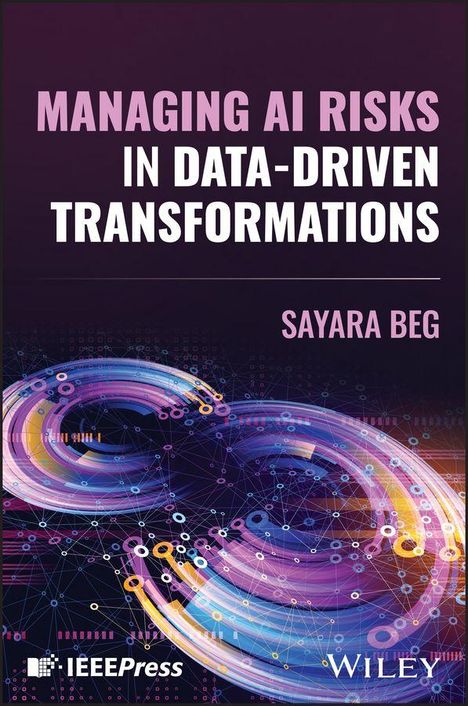
Sayara Beg: Managing AI Risk in Data-Driven Transformation, Gebunden
Managing AI Risk in Data-Driven Transformation
Sie können den Titel schon jetzt bestellen. Versand an Sie erfolgt gleich nach Verfügbarkeit.
- Verlag:
- John Wiley & Sons Inc, 12/2026
- Einband:
- Gebunden
- Sprache:
- Englisch
- ISBN-13:
- 9781394406814
- Artikelnummer:
- 12717012
- Umfang:
- 752 Seiten
- Erscheinungstermin:
- 21.12.2026
- Hinweis
-
Achtung: Artikel ist nicht in deutscher Sprache!
Klappentext
A structured governance framework for managing AI risks in data-driven transformations
Traditional risk frameworks fail to address the challenges AI introduces into change programs: probabilistic assessment breaks down under Knightian uncertainty, emergent system behaviour defies prediction, and human-in-the-loop oversight too often provides psychological rather than functional protection. Managing AI Risks in Data-Driven Transformations responds with the Human Firewall, an original governance framework that moves the term beyond its familiar cyber-security usage into a rigorous, three-pillar model of AI oversight, integrating ethical stewardship, institutional accountability, and behavioral assurance.
The book translates these pillars into auditable practice through a suite of practical instruments: the H-E-V-R risk assessment framework (Hazard, Exposure, Vulnerability, Response), the AI Ethics Risk Register, the Trust Impact Matrix, and the six-step Risk-Ethics Integrated Assessment (REIA) methodology, all aligned to the NIST AI Risk Management Framework, ISO/IEC 42001: 2023, IEEE 7000-2021, and the EU AI Act. Governance models, templates, reflective questions, and sector-based case studies from financial services, healthcare, and the public sector demonstrate how to navigate technical and organisational risks in an integrated way.
The book also covers:
- Why conventional probabilistic risk assessment is structurally inadequate for AI, and how automation bias and selective adherence undermine human oversight
- A new AI risk taxonomy addressing algorithmic opacity, bias, model drift, and hallucination, with trust calibration as the governance objective
- Accountability architectures for AI Ethics Boards and stewardship committees, including the Three Lines of Defence adapted for AI and contestability rights under the GDPR and EU AI Act
- Capability building from classroom to boardroom: AI literacy, certification pathways, and an AI Risk Leadership Framework
- AI governance maturity model and adaptive governance strategies for regulation and technology that continue to evolve
Designed for project and program managers, risk and governance professionals, and board directors leading AI-driven change, this book also supports professionals pursuing ChPP, CEng, and related chartered and certification pathways. It functions as a graduate textbook for MBA, MSc AI, Data Science, and Technology Management programs, and as a resource for executive education and professional CPD.