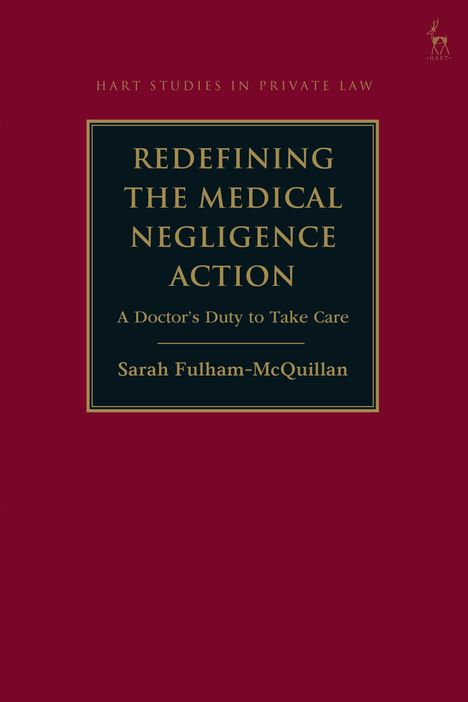
Sarah Fulham-McQuillan: Redefining the Medical Negligence Action, Gebunden
Redefining the Medical Negligence Action
- A Doctor's Duty to Take Care
Sie können den Titel schon jetzt bestellen. Versand an Sie erfolgt gleich nach Verfügbarkeit.
- Verlag:
- Bloomsbury Academic, 04/2027
- Einband:
- Gebunden
- Sprache:
- Englisch
- ISBN-13:
- 9781509931507
- Artikelnummer:
- 12790642
- Umfang:
- 224 Seiten
- Gewicht:
- 323 g
- Maße:
- 234 x 156 mm
- Stärke:
- 12 mm
- Erscheinungstermin:
- 15.4.2027
- Hinweis
-
Achtung: Artikel ist nicht in deutscher Sprache!
Klappentext
This ambitious and important book explores the new concept of the doctor-patient relationship, told from the private law perspective.
The doctor-patient relationship differs from others in negligence law. Doctors are required to take positive action and, therefore, can be held liable for omissions. However, because actionable damage is almost exclusively confined to physical injury, the significance of a doctor's liability for failing to confer a benefit has gotten lost along the way. This aspect of the doctor's positive duty is overlooked in both the case law and the literature - and, this book identifies it as the principal barrier to protecting interests other than bodily integrity in medical negligence law.
The book sets out a novel theoretical framework in which the reconceptualised doctor's 'positive duty to take care' of a patient's interests justifies an expanded concept of actionable damage beyond physical injury - ensuring that the reasons for requiring doctors to act positively are carried through to the damage enquiry. The book identifies that the leading cases causing challenges to coherency in medical negligence are those involving patient choice: Rees v Darlington Memorial Hospital, McFarlane v Tayside Health Board, Meadows v Khan, ACB v Thomson Medical Pte Ltd, Chester v Afshar, Montgomery v Lanarkshire Health Board, Gregg v Scott, and Philp v Ryan. Rather than treating patient autonomy as a source of doctrinal difficulty, this book offers a new way of thinking about the doctor-patient relationship to accommodate autonomy related interests and real world effects of medical negligence separate from physical injury.
The theoretical account of the doctor's positive duty and its consequences for actionable damage reveals what is distinctive about the doctor-patient relationship amongst other relationships giving rise to liability for omissions. It suggests how novel harms in medical negligence might be accommodated - including the potential for tort law in this area to reflect fundamental values in constitutional rights in Ireland and ECHR rights in the UK, and how the non-pecuniary losses could be quantified and compensated. While common law of Ireland and the UK takes centre stage, the analysis draws on other common law jurisdictions and on Irish constitutional law.