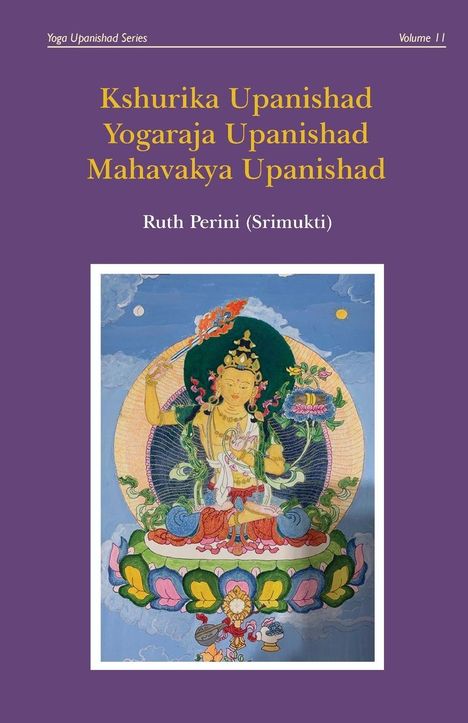
Ruth B Perini: Kshurika Upanishad Yogaraja Upanishad Mahavakya Upanishad, Kartoniert / Broschiert
Kshurika Upanishad Yogaraja Upanishad Mahavakya Upanishad
(soweit verfügbar beim Lieferanten)
- Verlag:
- Independent Publishing, 08/2026
- Einband:
- Kartoniert / Broschiert
- Sprache:
- Englisch
- ISBN-13:
- 9780648910794
- Artikelnummer:
- 12903043
- Umfang:
- 112 Seiten
- Gewicht:
- 152 g
- Maße:
- 216 x 140 mm
- Stärke:
- 6 mm
- Erscheinungstermin:
- 6.8.2026
- Hinweis
-
Achtung: Artikel ist nicht in deutscher Sprache!
Klappentext
The book contains three short Upanishads: Kurika, Yogarja and Mahvkya. Kurika means 'razor' which is likened to the yogic practices which cut through the aspirant's attachments and ignorance. The Upaniad starts with an invocation, in which the aspirant seeking spiritual revelation prays for peace, energy and understanding for all who are inquiring into its meaning and message. They need the help of the Divine as it is difficult to remove worldly attachments. To achieve the goal of freedom from attachments, perfect concentration is needed. The practice of n odhana, alternate nostril breathing, must be practised to destroy the impurities in the ns. There are detailed instruction on breath control, pryama, to move the pra, energy, up suumn n to the heart, then the throat, then the eyebrow centre and finally the crown of the head. On the way, the life-force in the marmans, vulnerable areas of the body, can be freed by the practice of pryama. No longer trapped in the web of desires and attachment, the yogin attains true liberation. Yogarja means 'royal yoga', as it is the most effective path for attainment in yoga. The Upaniad has twenty-one verses, which begin by declaring that the four yogas of mantra, laya, häha and rja must be understood and practised for perfection in yoga. They all include the stages of sana, pryama, dhyna and samdhi. The next five to eighteen verses describe the nine chakras: brahma, svdhihna, nbhi, hdaya, viuddhi, tluk, ghäa, bhr, brahmarandhra, and vyoma. The Upaniad concludes that the sage who meditates on each of the nine chakras, through practice and supreme grace, gradually attains liberation.
The Mahvkya Upaniad is connected with the Atharvaveda, and consists of twelve verses. In the first two verses Lord Brahman emphasises that it should only be taught to those who wish to know the inner true Self and are not entangled in worldly life. The aspirant must withdraw from knowledge through the senses. Vision through the sense organs conceals the all-pervading Brahman from that which, to the ignorant, appears permanent and indestructible, such as a mountain, the earth and even the whole universe. The tman is the inner sun in the heart. It is the pure consciousness, without desires, self-illuminating with its own fire. Whoever continually repeats the mantra so'ham becomes paramtm, existence-thought-bliss. This is the unique message of advaita-vednta: tat tvam asi (that thou art), one of the Mahvkyas, Great Statements.