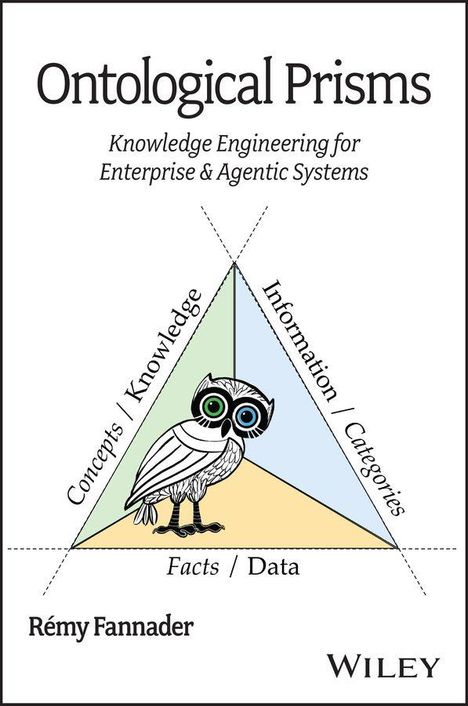
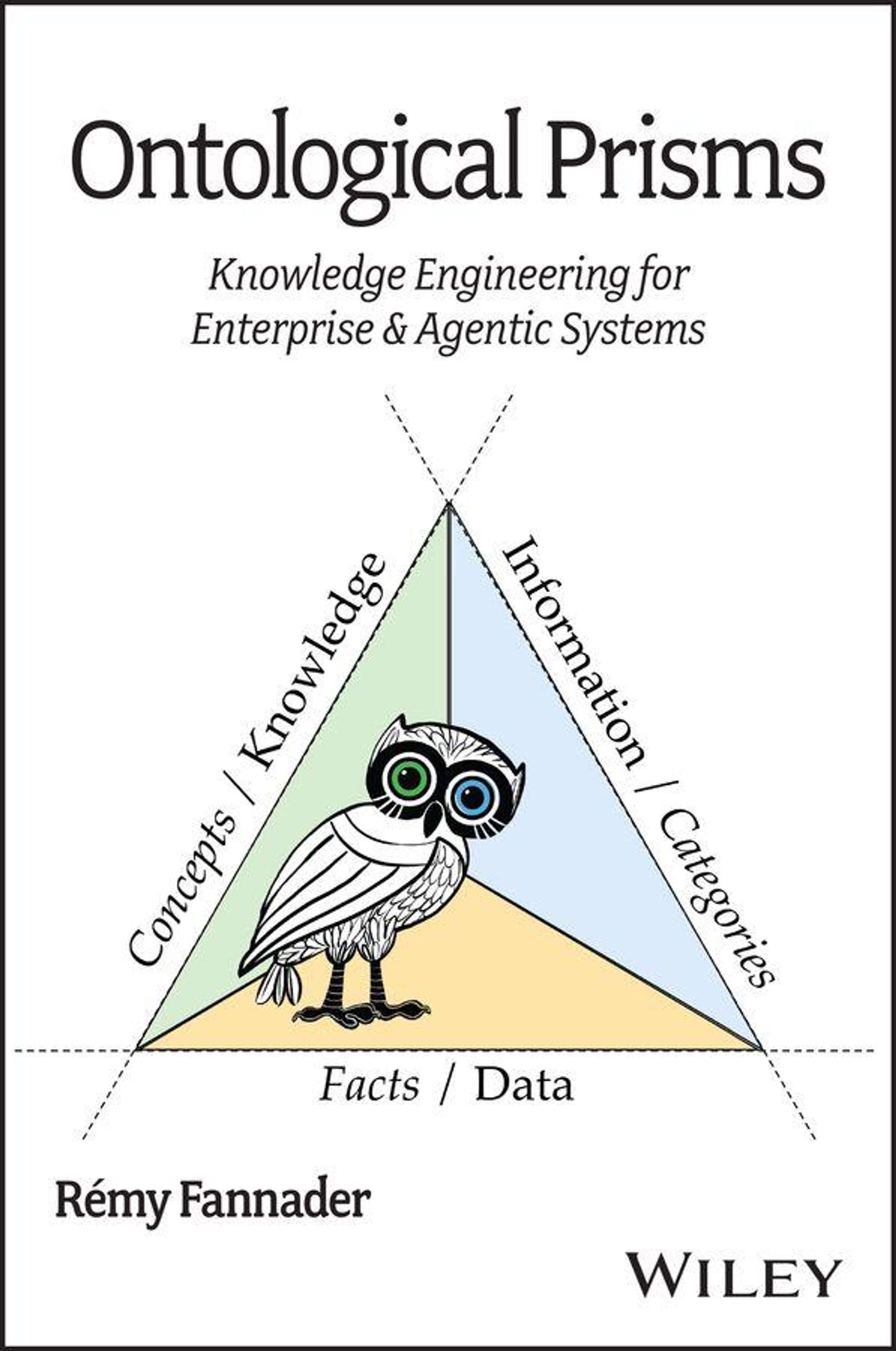
Remy Fannader: Ontological Prisms, Gebunden
Ontological Prisms
- Knowledge Engineering for Enterprise & Agentic Systems
(soweit verfügbar beim Lieferanten)
- Verlag:
- Wiley, 07/2026
- Einband:
- Gebunden
- Sprache:
- Englisch
- ISBN-13:
- 9781394352623
- Artikelnummer:
- 12648004
- Umfang:
- 352 Seiten
- Gewicht:
- 590 g
- Maße:
- 231 x 157 mm
- Stärke:
- 25 mm
- Erscheinungstermin:
- 14.7.2026
- Hinweis
-
Achtung: Artikel ist nicht in deutscher Sprache!
Klappentext
Ontological Prisms
The expansion of generative AI has highlighted the limitations of purely neural approaches and the benefits of coupling them with symbolic counterparts epitomized by ontologies. While knowledge graphs emerge as the jack of all trades among agents dealing with language, knowledge, and orchestration, there is little consensus on the sources and roles of ontologies, in other words, knowledge.
The book introduces ontological prisms, a game-changing paradigm that unfolds the geometry of knowledge into a triptych of observed worlds (facts), meanings (concepts), and shared representations (categories).
This approach entails three major breakthroughs with regard to:
- Interoperability: by establishing a principled and actionable distinction between communication (language) and representation (knowledge), ontological prisms provide a blueprint for semantic and conceptual layers set across heterogeneous representations
- Abstraction levels: leveraging its three-pronged paradigm, ontological prisms untangle the abstraction conundrum between upper (or foundational) and lower (or domain-specific) level ontologies. This allows for a smooth, declarative integration of ontological abstractions without imposing unwieldy inheritance hierarchies
- Temporality: the epistemic distinction between worlds (facts), intents (concepts), and representations (categories), combined with differentiated abstraction semantics, enables diachronic knowledge management alongside concurrent engineering processes, regardless of domain overlaps and misaligned life cycles
These advances allow for a seamless integration of knowledge engineering between agentic and enterprise systems: facts, categories, and concepts for the former, mapped to data, information, and knowledge for the latter, respectively. That knowledge-driven integration of cognitive and systems capabilities paves the way to a holistic approach to collective learning weaving together individuals, organizations, and systems.
The book is organized into three parts: principles, foundations, and architecture; cognitive functions: language, reasoning, and judgment; and systems and knowledge engineering. The third part introduces the KEOPS (Knowledge Engineering with Ontological Prisms) methodology, accompanied by a kernel developed with OWL/Prot??g??.
This organization allows for differentiated readings for graduates, engineers, and consultants, ensuring a comprehensive understanding of agentic cognition, knowledge engineering and ontology development, as well as business intelligence and decision-making systems.