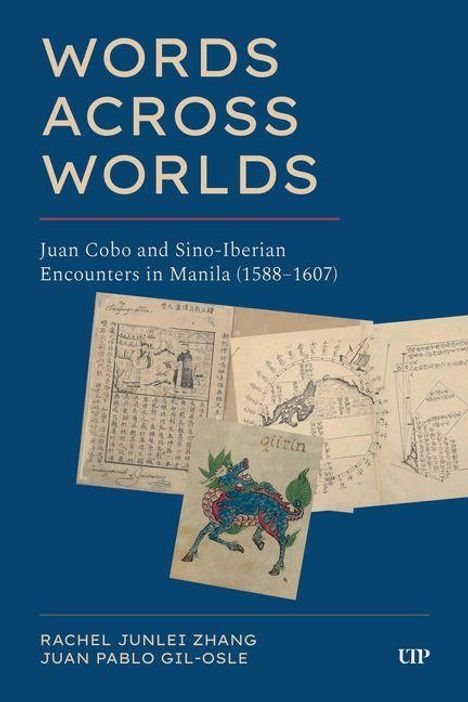
Rachel Zhang: Words Across Worlds, Gebunden
Words Across Worlds
- Juan Cobo and Sino-Iberian Encounters in Manila (1588-1607)
Lassen Sie sich über unseren eCourier benachrichtigen, sobald das Produkt bestellt werden kann.
- Verlag:
- University of Toronto Press, 03/2027
- Einband:
- Gebunden
- Sprache:
- Englisch
- ISBN-13:
- 9781049805535
- Umfang:
- 232 Seiten
- Erscheinungstermin:
- 16.3.2027
- Hinweis
-
Achtung: Artikel ist nicht in deutscher Sprache!
Ähnliche Artikel


Klappentext
Words across Worlds examines the role of Chinese texts, language, and knowledge in shaping early Spanish missionary and intellectual activity in Manila at the turn of the seventeenth century. Centred on the figure of the Dominican friar Juan Cobo, it situates his writings within a broader network of trans-Pacific and transatlantic exchanges linking Fujian, Manila, Mexico, and Spain.
Drawing on book history, translation studies, and intellectual history, the study analyses a corpus of Sino-Hispanic works -- including translations, catechisms, scientific treatises, and cartographic materials -- to reveal how knowledge circulated across linguistic, cultural, and imperial boundaries. The book emphasizes the material and interpretive processes through which Chinese books were acquired and collected by the Habsburg family, and translated, annotated, and repurposed by missionaries. It pays particular attention to marginalia, printing practices, and linguistic strategies, highlighting both the possibilities and the limits of cultural accommodation. By examining neglected or understudied texts such as Cobo's Beng Sim Po Cam , Bian zhengjiao zhenchuan shilu , and the Doctrina Christiana in Chinese, the study also reconstructs their reception and eventual marginalization within both Chinese and Spanish traditions.
Ultimately, the book argues that early modern Manila was a crucial site of global knowledge production, where Chinese and European epistemologies intersected in complex and often unstable ways. These encounters not only facilitated the transmission of religious and scientific ideas but also exposed the tensions inherent in cross-cultural communication, offering a new perspective on the intellectual history of early globalization.