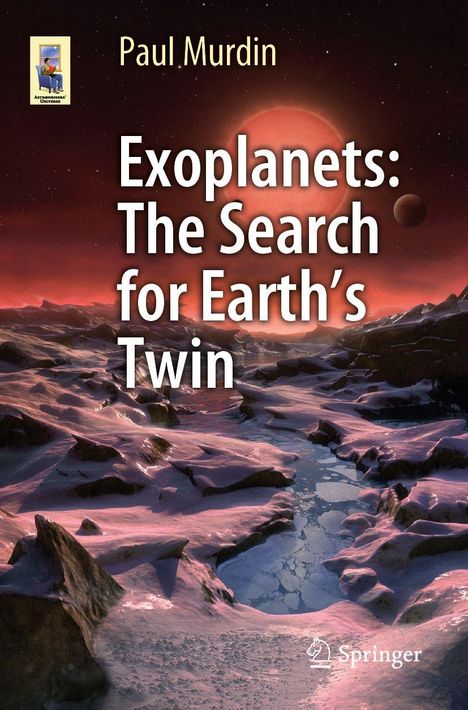
Paul Murdin: Exoplanets: The Search for Earth's Twin, Kartoniert / Broschiert
Exoplanets: The Search for Earth's Twin
(soweit verfügbar beim Lieferanten)
- Verlag:
- Springer Nature Switzerland AG, 07/2026
- Einband:
- Kartoniert / Broschiert
- Sprache:
- Englisch
- ISBN-13:
- 9783032226839
- Artikelnummer:
- 12790666
- Umfang:
- 163 Seiten
- Erscheinungstermin:
- 12.7.2026
- Serie:
- Astronomers' Universe
- Hinweis
-
Achtung: Artikel ist nicht in deutscher Sprache!
Klappentext
It has been recognised for centuries that, statistically, the Earth must be one of many, literally billions, of planets in our Galaxy, but the first planets beyond the solar system were recognised only 30 years ago. This book sets out to show the variety of the over 6, 000 planets orbiting other stars that are now known by describing 50 of them. Few resemble our own Earth, although the largest telescopes and the most advanced spacecraft have been deployed to find them, as well as smaller scale projects operated by less wealthy but clever scientists, including amateurs and students.
While we have no indications yet of new life and new civilisations, we have definitively found strange new worlds, some stranger than either science or science fiction has previously imagined.
- Rocky worlds like the Moon, some stiflingly hot, some ice-covered, one or two tantalisingly like the Earth in some respects
- A planetary system with seven planets, some of them Earth-sized and in the habitable zone of the system where liquid water and therefore life are possible
- An ocean-covered planet, like Earth in Kevin Costner's film Waterworld, apparently with chemical biosignatures
- A world covered with volcanoes; one side permanently lit up by hot lava outflows
- A zombie planetary system of three planets, re-formed from the body of an exploded star, orbiting a star that is not quite dead
- Planets orbiting a double star (two stars like our Sun), like Tattooine in Star Wars, some with a disorientingly complex day / night cycle
- A planet in a star cluster whose night-time skies are ablaze with the light of a million stars
- A giant planet with one side perpetually facing its sun, roasting, with superheated gales blowing into the cold side, carrying glass rain
The book describes the discovery of the selected planets: the how, the who, the determination, the luck and the feuds. Each planet's wider planetary system is mapped out. The constitution of each planet is described, with the most significant conclusions about its surface and atmosphere, and comparing each to Earth. Each entry is written within the limits of scientific knowledge, a sedentary exploration of each strange new world, extrapolated from but firmly grounded in the science. Within the book's chapters there are descriptions of the various classes of worlds recognised by planetary scientists and their techniques. The author ends by discussing what makes a world habitable and how close we have come to discovering a planetary system like ours and a planet like Earth -- or even one that is better for life to live on.
Biografie
Paul Murdin ist Professor am Institute of Astronomy der Cambridge University und ehemaliger Präsident der European Astronomical Society. Als Direktor für Wissenschaft des British National Space Centre war er zehn Jahre lang maßgeblich an der Planung und Durchführung britischer Raumfahrt- und Astronomieprojekte beteiligt. Er zählte als Forschungsastronom zu den ersten wissenschaftlichen Mitgliedern des Anglo-Australian Observatory und hat auch in den USA sowie auf den Kanarischen Inseln gelebt und gearbeitet, wo er am Aufbau des englisch-holländischen Observatoriums in La Palma mitwirkte. Er ist Mitglied der britischen Royal Astronomical Society und erhielt 1988 für seine Verdienste um die Astronomie den OBE (Order of the British Empire). Zu seinen Entdeckungen gehören das schwarze Loch im Stern Cygnus X-1, die Lichtblitze des Vela-Pulsars und die Natur des ungewöhnlichen Sterns SS433. Murdin ist außerdem ein bekannter Wissenschaftsvermittler, der in Büchern, Artikeln, Fernseh- und Radiosendungen (etwa für die BBC und für CNN) astronomische Themen aufbereitet.