
Patrick Nehr-Baseler: Sterbekunst als Selbstsorge zwischen Vergangenheit und Zukunft, Gebunden
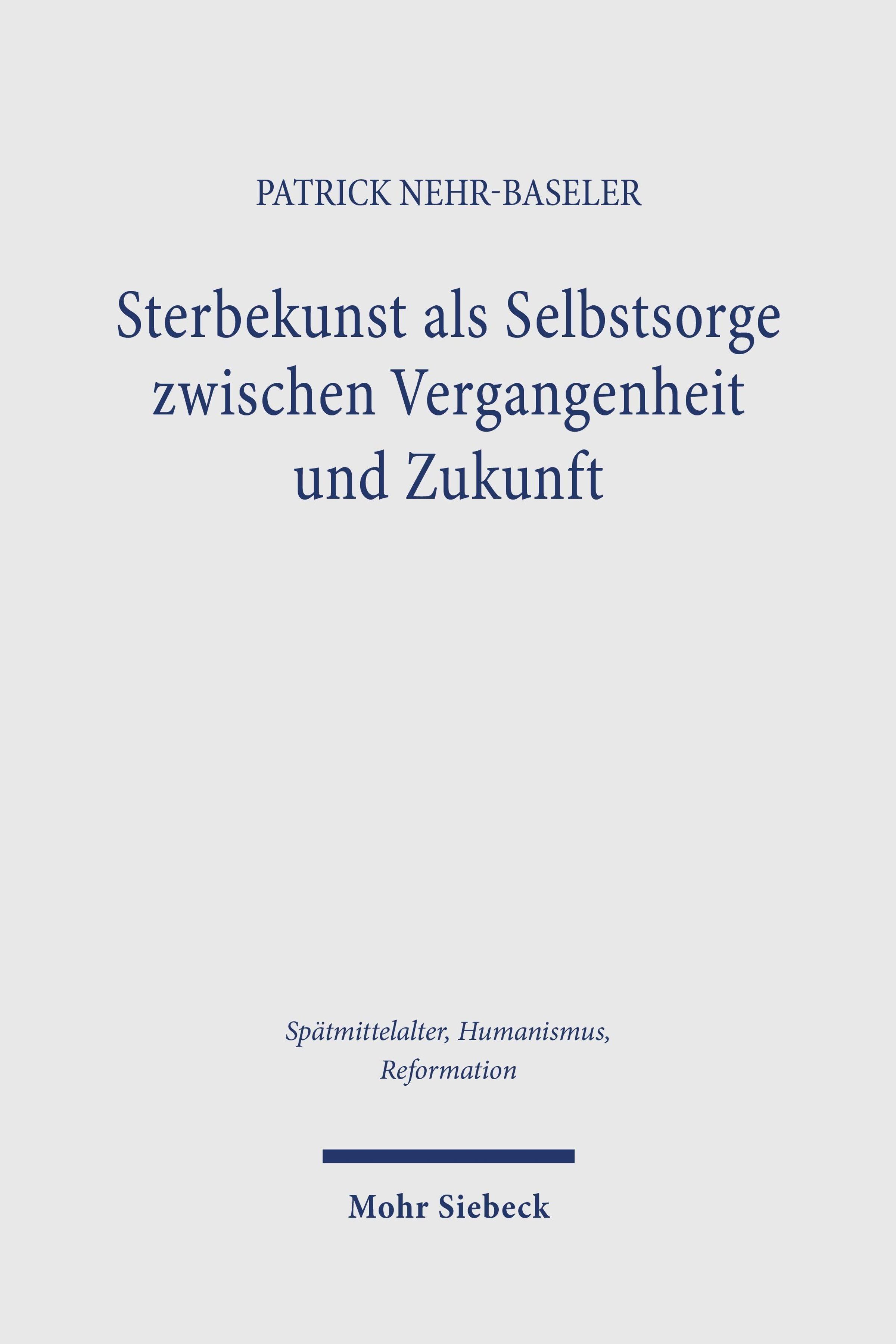
Sterbekunst als Selbstsorge zwischen Vergangenheit und Zukunft
- Frühneuhochdeutsche artes moriendi in Augsburger Inkunabeln und Frühdrucken (1472-1519)
Sie können den Titel schon jetzt bestellen. Versand an Sie erfolgt gleich nach Verfügbarkeit.
- Verlag:
- Mohr Siebeck GmbH & Co. K, 01/2027
- Einband:
- Gebunden
- Sprache:
- Deutsch
- ISBN-13:
- 9783162009142
- Artikelnummer:
- 12922169
- Umfang:
- 450 Seiten
- Erscheinungstermin:
- 31.1.2027
Klappentext
Patrick Nehr-Baseler examines late medieval texts on preparing for and accompanying a good death ( artes moriendi ) to determine what forms of self-care they convey and to what extent they outline specific ways of engaging with one's own future. In doing so, he combines recent research on medieval self-care with studies on the perception of time and self-positioning. Against this backdrop, he posits the hypothesis that people in the late Middle Ages understood the tense period between the present and their own death as a space for reflection and as a realm of possibilities for salvation-oriented self-care.
The starting point of the study is a textual-hermeneutic and incunabula analysis of a miscellany from the Benedictine monastery of St. Ulrich and Afra in Augsburg (1473) and its second edition from 1476. The print is characterized by a condensation of various temporal semantics of eschatology and serves as the starting point for an examination of a corpus of 33 additional incunabula and early prints published in Augsburg between 1472 and 1519. These are systematically analyzed in terms of their collection and textual contexts. In this way, the author combines the analysis of material printing contexts with questions of textual hermeneutics as well as the history of theology, piety, and media.
The author demonstrates that artes moriendi are not focused solely on individual eschatology. Within their respective contexts of printing and transmission, they develop concepts of self-care that aim both at contemplative imaginings of the future and at organizing the time remaining in one's life. At the same time, it becomes clear that anthologies and the contexts in which these works appear significantly shape the meaning of the artes moriendi , and that printers and printing houses emerge as active shapers of religious discourse. Patrick Nehr-Baseler thus contributes to a reassessment of late medieval devotional practices and demonstrates that questions of self-care and future orientation can only be historically understood through the interplay of text, materiality, and the context of printing.
Anmerkungen:
Bitte beachten Sie, dass auch wir der Preisbindung unterliegen und kurzfristige Preiserhöhungen oder -senkungen an Sie weitergeben müssen.