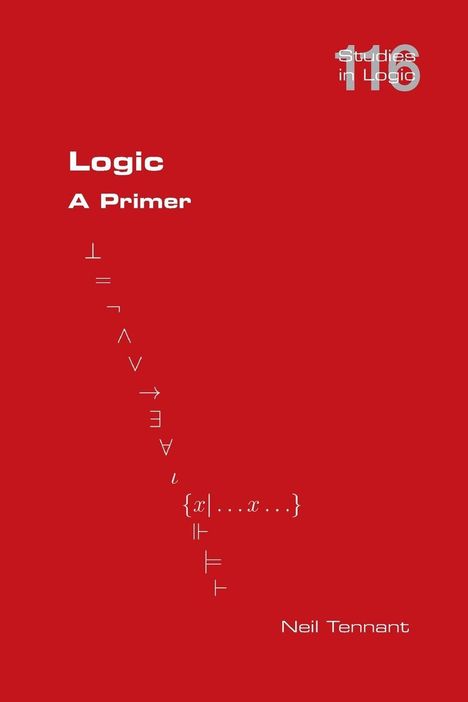
Neil Tennant: Logic. A Primer, Kartoniert / Broschiert
Logic. A Primer
(soweit verfügbar beim Lieferanten)
- Verlag:
- College Publications, 04/2026
- Einband:
- Kartoniert / Broschiert
- Sprache:
- Englisch
- ISBN-13:
- 9781848905061
- Artikelnummer:
- 12695973
- Umfang:
- 432 Seiten
- Gewicht:
- 655 g
- Maße:
- 234 x 156 mm
- Stärke:
- 23 mm
- Erscheinungstermin:
- 16.4.2026
- Hinweis
-
Achtung: Artikel ist nicht in deutscher Sprache!
Klappentext
This introduction to formal logic is for students of Philosophy, Mathematics, Computer Science, and / or Linguistics. Philosophically sensitive, historically and linguistically informed, and mathematically precise, it deals with fundamentals.
Its distant ancestor Natural Logic married Gentzenian proof theory to Tarskian model-theoretic semantics; and distinguished the important subsystem of Intuitionistic Logic. The author has since published research on capturing relevance proof-theoretically, and extending Tarskian semantics with model-relative truthmakers and falsitymakers. These later ideas are expounded here at a gentler level.
The coverage is largely at the 'object level'. It gets the main innovative ideas across in systematic fashion. A plethora of exercises serve concept and skill acquisition: translating between English sentences and formal sentences of first-order logic; finding formal proofs of valid arguments; and finding counterexamples to invalid ones. The text distinguishes constructive from 'strictly classical' reasoning. It also signposts significant metalogical results to be established in a sequel.
The approach is strongly proof-theoretical. Primitive rules of inference governing logical operators flow from left-to-right readings of the famous two-valued truth tables. Modelrelative truthmakers and falsitymakers are constructed using rules of semantic evaluation.
These rules morph seamlessly into model-invariant rules of natural deduction for connectives and quantifiers. These, in turn, are rendered as logical rules of the sequent calculus. The deductive rules gestated from the rules of evaluation guarantee relevance of premises of deductive proofs to their conclusions.
The text lays firm foundations for the concepts of soundness and completeness of a proof system with respect to a semantics. It shows that its proof system meets all the methodological demands on a logic for formalizing deductive reasoning (whether constructive or classical) in both mathematics and science.
Quine famously and approvingly called the language of first-order logic Grade A idiom. It is now equipped with what one can call Grade A argumentation.