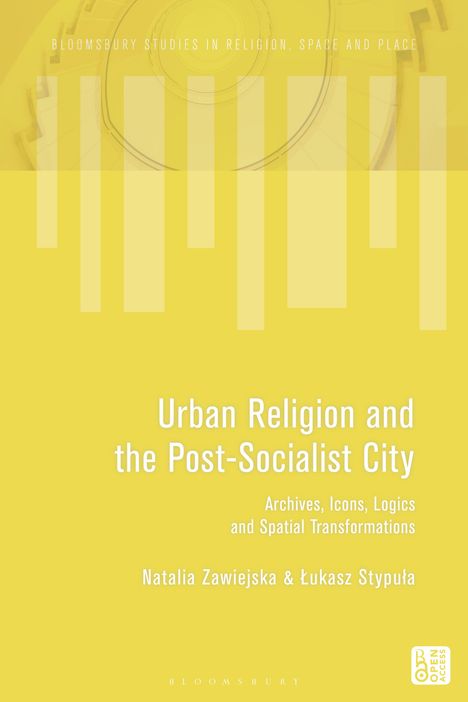
Natalia Zawiejska: Urban Religion and the Post-Socialist City, Gebunden
Urban Religion and the Post-Socialist City
- Archives, Icons, Logics and Spatial Transformations
Sie können den Titel schon jetzt bestellen. Versand an Sie erfolgt gleich nach Verfügbarkeit.
- Herausgeber:
- Paul-François Tremlett, John Eade
- Verlag:
- Bloomsbury Publishing plc, 04/2027
- Einband:
- Gebunden
- Sprache:
- Englisch
- ISBN-13:
- 9781350576353
- Artikelnummer:
- 12690642
- Umfang:
- 272 Seiten
- Gewicht:
- 454 g
- Maße:
- 234 x 156 mm
- Stärke:
- 25 mm
- Erscheinungstermin:
- 15.4.2027
- Hinweis
-
Achtung: Artikel ist nicht in deutscher Sprache!
Klappentext
This open access book rethinks urban religion in the context of the social, economic and political transformations in post-socialist Central and Eastern Europe.
Grounded in extensive ethnographic studies conducted in three major cities in Poland - Kraków, Gdansk and Lublin - this book engages, critiques and expands the framework of urban religion. It disentangles the concept of urban religion from specific religious traditions, instead presenting it as a modality of urban life that is embedded in a vast social field. Through its focus on Poland, it furthermore argues and shows that the Western-centric theories on religion in urban space that dominate the field do not fully capture the religious infrastructures, practices and dynamics that characterize post-socialist regions in Central and Eastern Europe.
Engaging digital humanities and using innovative experimental methodologies - including mapping, archiving, assembling, aggregating and scaling - to analyse an extensive data set of more than 22, 000 records collected in the urban public sphere, the book introduces new descriptive and analytical categories and tools for understanding the place of religion in the social lives of cities in this region and beyond. These categories for capturing and making sense of the urban-religious logics of the post-socialist city include - among others - protest, taboo, commemoration, absence, 'non-religion', and a mistake-unruliness composite. By introducing a range of new concepts and methodologies, and by centring post-socialist urban formations, this book provides an important critical intervention in the study of urban religion.