Nader Hozhabri: Liberty and the Structure of Power, Kartoniert / Broschiert
Liberty and the Structure of Power
- From Western Political Philosophy to Their Obscurity in Iran
(soweit verfügbar beim Lieferanten)
- Verlag:
- Sturnus, 06/2026
- Einband:
- Kartoniert / Broschiert
- Sprache:
- Persisch
- ISBN-13:
- 9783946451334
- Artikelnummer:
- 12773947
- Umfang:
- 126 Seiten
- Gewicht:
- 128 g
- Maße:
- 190 x 120 mm
- Stärke:
- 8 mm
- Erscheinungstermin:
- 9.6.2026
- Hinweis
-
Achtung: Artikel ist nicht in deutscher Sprache!
Klappentext
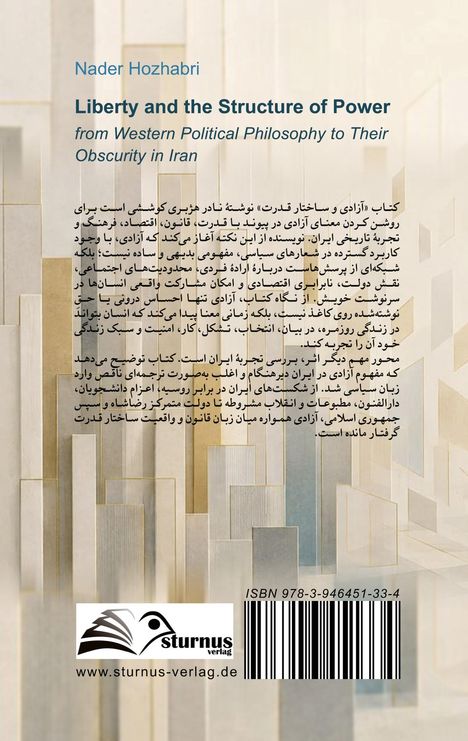
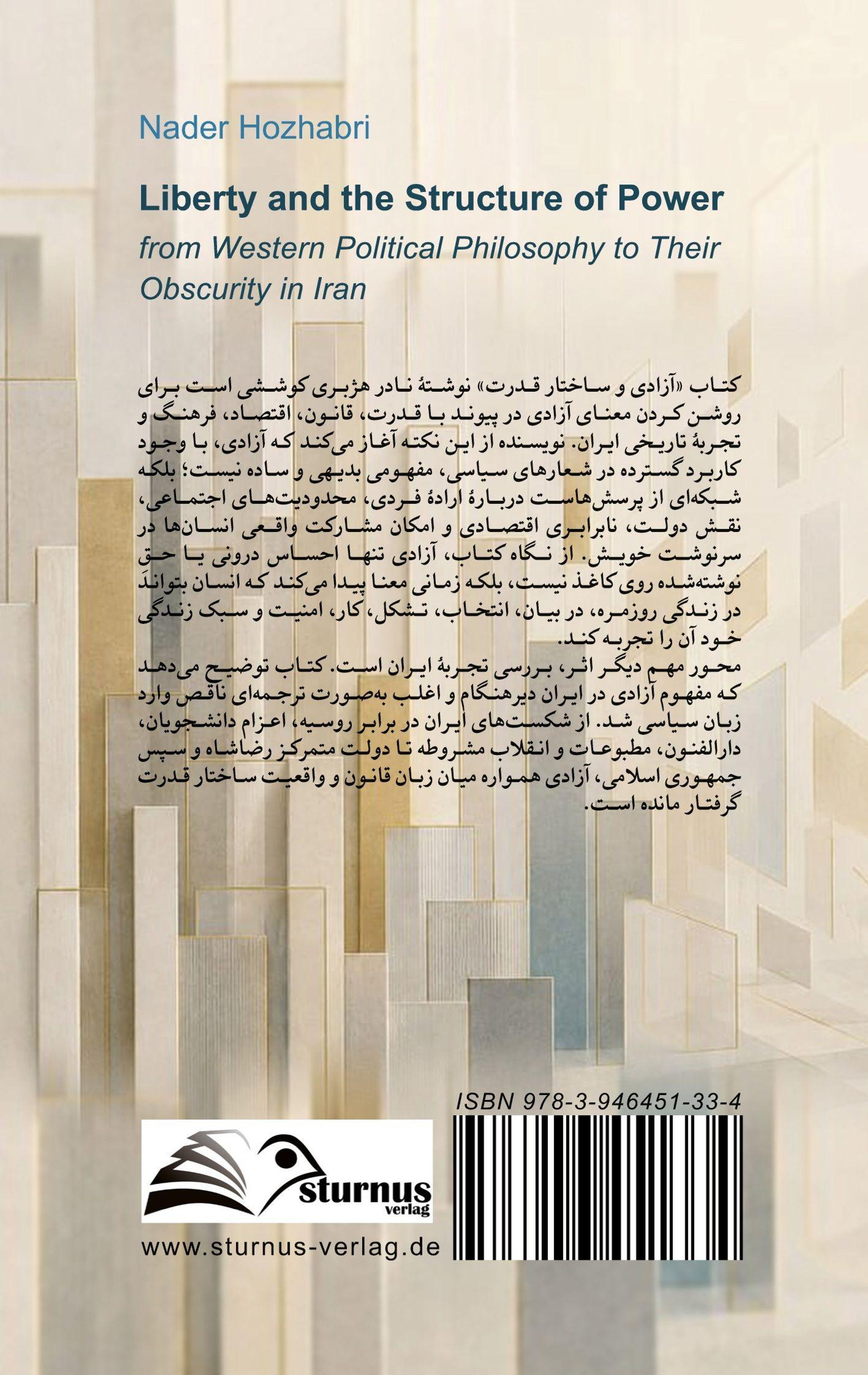
The book "Liberty and the Structure of Power: From Western Political Philosophy to Their Obscurity in Iran" by Nader Hozhabri is an attempt to clarify the meaning of freedom in relation to power, law, economy, culture, and Iran's historical experience. The author begins from the premise that freedom, despite its widespread use in political slogans, is not a self-evident or simple concept. Rather, it is a network of questions concerning individual will, social limitations, the role of the state, economic inequality, and the possibility of people's genuine participation in shaping their own destiny. From the perspective of the book, freedom is not merely an inner feeling or a right written on paper; it acquires meaning only when people are able to experience it in everyday life: in expression, choice, association, work, security, and their way of life. The opening sections of the book distinguish between negative freedom and positive freedom. Negative freedom means freedom from external interference and coercion; positive freedom means having the capacity, opportunity, and resources necessary to live and act. The author shows that neither of these two meanings is sufficient on its own: if freedom is reduced merely to the absence of obstacles, poverty, discrimination, and insecurity are ignored; and if positive freedom is entrusted absolutely to the state in the name of the common good or justice, it can lead to authoritarianism. From this point, the book establishes a dialogue among different intellectual traditions, from Kant, Rousseau, Locke, Mill, Berlin, and von Hayek to Marx, Gramsci, Luxemburg, Habermas, Honneth, and the Frankfurt School. Another major focus of the work is the examination of Iran's experience. The book explains that the concept of freedom entered Iran's political language rather late and often in the form of an incomplete translation. From Iran's defeats against Russia, the dispatch of students abroad, the establishment of Dar al-Funun, the press, and the Constitutional Revolution to Reza Shah's centralized state and later the Islamic Republic, freedom has always remained caught between the language of law and the reality of the structure of power.
Anmerkungen:
Bitte beachten Sie, dass auch wir der Preisbindung unterliegen und kurzfristige Preiserhöhungen oder -senkungen an Sie weitergeben müssen.