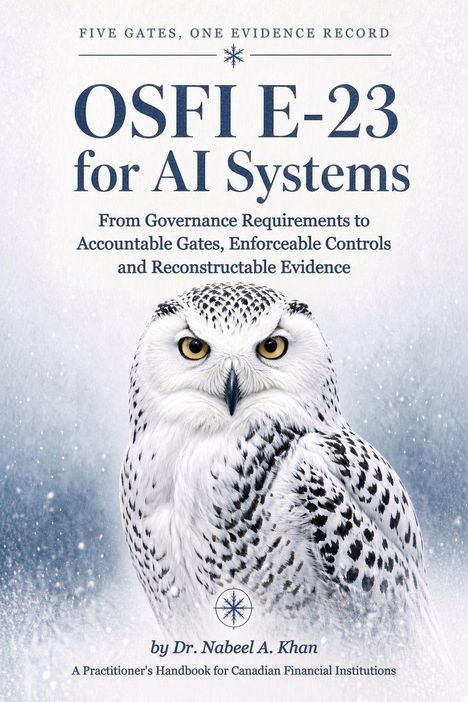
Nabeel A. Khan: OSFI E-23 for AI Systems, Kartoniert / Broschiert
OSFI E-23 for AI Systems
- From Governance Requirements to Accountable Gates, Enforceable Controls and Reconstructable Evidence - A Practitioner's Handbook for Canadian Financial Institutions
(soweit verfügbar beim Lieferanten)
- Verlag:
- iSystematic Inc., 11/2026
- Einband:
- Kartoniert / Broschiert
- Sprache:
- Englisch
- ISBN-13:
- 9781067896058
- Artikelnummer:
- 12974140
- Umfang:
- 212 Seiten
- Gewicht:
- 292 g
- Maße:
- 229 x 152 mm
- Stärke:
- 11 mm
- Erscheinungstermin:
- 5.11.2026
- Serie:
- iSystematic Inc.
- Hinweis
-
Achtung: Artikel ist nicht in deutscher Sprache!
Klappentext
A guideline does not govern a model. It describes what an institution should be able to show about one, and leaves the institution to decide how.
Guideline E-23, Model Risk Management (2027), from the Office of the Superintendent of Financial Institutions (OSFI), takes effect on 1 May 2027 for all federally regulated financial institutions, foreign bank and foreign insurance company branches included. Its definition of a model names AI and machine learning methods, and every model whose inherent risk is determined to be non-negligible enters the inventory and full lifecycle governance. The assistant, the underwriting model and the vendor score now sit beside the scorecard, whose validation method assumed an object that held still.
This handbook is an implementation and operating method for bringing AI systems into a model risk lifecycle under E-23. It keeps two things apart on every page: what the guideline says and what the book's discipline recommends. Where the book asks for one named person to sign at each gate, that is the discipline's choice; E-23 permits a unit, an individual or a committee.
Three primary concepts
The Five-Gate Deployment Model(TM) says when accountability must occur: Data and Design, Validation, Approval, Deployment and Operation, in order, each with entry criteria and a required evidence record.
The Boundary Invariant says what a system must refuse. A boundary is a clause the optimizer may not cross; everything else is optimization.
The evidence layer says what a system must prove afterward: model registry, retrieval ledger, policy version, tool authorization record and trigger bus, emitted by the build, every gate record shaped as a BOE Declaration.
Supporting chapters take the discipline to agents through PEVG (Planner, Executor, Verifier, Generator) and PARA (Perception, Action, Reasoning, Adaptation), to retrieval corpora at the first gate, to vendor models through the AI Vendor Risk Framework (AVRF)(TM) and to monitoring through a trigger register. The readiness plan places every gap with the MESA Framework(TM). A variant chapter re-reads every chapter for a US bank and a US insurer.
What you produce
Worked on one system of your own, the chapters produce five artifacts:
five gate records, each naming one accountable person
one BOE Declaration: the boundary a control fixes, the optimizer it frees and the evidence that the boundary held
one vendor scored, with a gate decision
a trigger register, every trigger armed and owned
a dated gap plan with one named owner per gap
Three fictional institutions carry the argument: a bank whose assistant made a commitment the bank never intended, an insurer whose drifting model reported its breaches to an unowned mailbox, and a trust and loan company running a vendor score that was never validated. Templates for the five artifacts are downloads named in the chapters, not printed in the book.
Who this book is for
Model risk management, AI governance and responsible AI, and enterprise AI architecture and engineering, the functions that meet at the seam between the person who signs and the person whose build is signed on. Internal audit, operational risk, compliance and regulatory risk read it for the record it leaves behind. The work is sponsored by, and reported to, the Chief Risk Officer, Chief Model Risk Officer, Chief Information Officer, Chief Data Officer and Chief AI Officer.
Evidence designed in is a query. Evidence reconstructed after is an investigation.
Nothing in this book makes an institution anything. It makes a record that can be read. OSFI does not endorse, approve or recommend this book, its author or any framework in it.