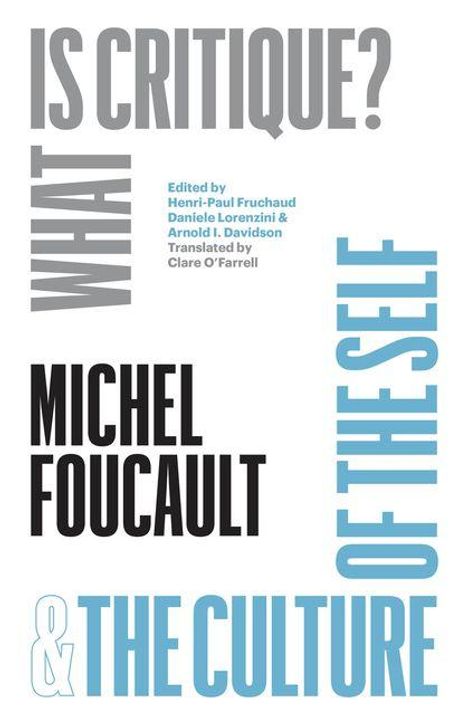
Michel Foucault: "What Is Critique?" and "The Culture of the Self", Kartoniert / Broschiert
"What Is Critique?" and "The Culture of the Self"
Sie können den Titel schon jetzt bestellen. Versand an Sie erfolgt gleich nach Verfügbarkeit.
- Herausgeber:
- Arnold I. Davidson, Daniele Lorenzini, Henri-Paul Fruchaud
- Übersetzung:
- Clare O'Farrell
- Verlag:
- The University of Chicago Press, 01/2027
- Einband:
- Kartoniert / Broschiert
- Sprache:
- Englisch
- ISBN-13:
- 9780226854427
- Artikelnummer:
- 12826942
- Umfang:
- 208 Seiten
- Gewicht:
- 454 g
- Maße:
- 216 x 140 mm
- Stärke:
- 20 mm
- Erscheinungstermin:
- 5.1.2027
- Serie:
- The Chicago Foucault Project
- Hinweis
-
Achtung: Artikel ist nicht in deutscher Sprache!
Klappentext
Newly published lectures by Foucault on critique, Enlightenment, and the care of the self --now in paperback.
On May 27, 1978, Michel Foucault gave a lecture to the French Society of Philosophy where he redefined his entire philosophical project in light of Immanuel Kant's 1784 text "What Is Enlightenment?" Foucault strikingly characterizes critique as the political and moral attitude consisting in the "art of not being governed like this," one that performs the function of destabilizing power relations and creating the space for a new formation of the self within the "politics of truth."
This volume presents the first critical edition of this crucial lecture alongside a previously unpublished lecture about the culture of the self and three public debates with Foucault at the University of California, Berkeley, in April 1983. There, for the first time, Foucault establishes a direct connection between his reflections on the Enlightenment and his analyses of Greco-Roman antiquity. However, far from suggesting a return to the ancient culture of the self, Foucault invites his audience to build a "new ethics" that bypasses the traditional references to religion, law, and science.
Mehr von Michel Foucault