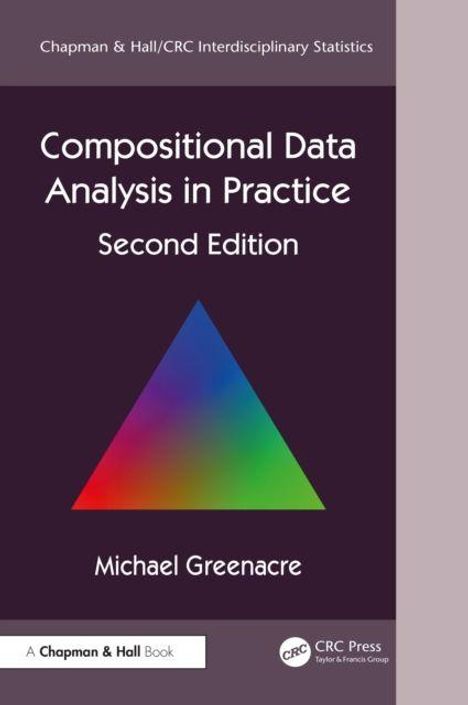
Michael Greenacre: Compositional Data Analysis in Practice, Kartoniert / Broschiert
Compositional Data Analysis in Practice
Sie können den Titel schon jetzt bestellen. Versand an Sie erfolgt gleich nach Verfügbarkeit.
- Verlag:
- Taylor & Francis Ltd, 12/2026
- Einband:
- Kartoniert / Broschiert
- Sprache:
- Englisch
- ISBN-13:
- 9781041235422
- Artikelnummer:
- 12845561
- Umfang:
- 190 Seiten
- Nummer der Auflage:
- 26002
- Ausgabe:
- 2 ed
- Erscheinungstermin:
- 23.12.2026
- Hinweis
-
Achtung: Artikel ist nicht in deutscher Sprache!
Klappentext
"This book is a small gem that will find its place among those who are interested in learning about this important topic from a master of clarity and exposition ... Graduate students and applied researchers, across the quantitative sciences who encounter proportional data, will find this an authoritative yet accessible guide."
~Michael Friendly, Professor, York University, Canada
"This book is an inspiring text for applied scientists and graduate students with backgrounds in multivariate analysis and are interested in mastering the analysis of compositional data."
~Jan Graffelman, Professor, Technical University of Catalonia, Spain
"This book would make for a wonderful one-semester course in applied multivariate statistics, suitable for upper-level undergraduates or master's students in data science."
~Trevor Hastie, The John A. Overdeck Professor, Professor of Statistics and Biomedical Data Science (emeritus), Stanford University, USA
Compositional data - proportions, percentages, and any data that sum to a constant - appear across virtually every scientific discipline, from geochemistry and ecology to political science and genomics. This thoroughly revised and extended second edition of Compositional Data Analysis in Practice continues to provide a simple and accessible treatment of compositional data analysis (CoDA) in a pedagogical format.
Key Features of the Second Edition Sixty percent more material than the first edition
Additional chapters on weighting of compositional parts, the analysis of complete compositions, the analysis of shape, high-dimensional genomic compositions, as well as two more case studies
Practical, example-driven approach, using 13 different data sets across different disciplines
Unique eight-pages-per-chapter format to facilitate both self-study and teaching of the subject
Revision of the easyCODA R package to include new features such as amalgamation clustering and variable selection in unsupervised and supervised learning
The book is a valuable resource for practitioners in all applied areas where compositional data are encountered, including bio- and geochemistry, food research, genomics, ecology, linguistics, marketing, financial budgets in economics, and time use in behavioural research and epidemiology.