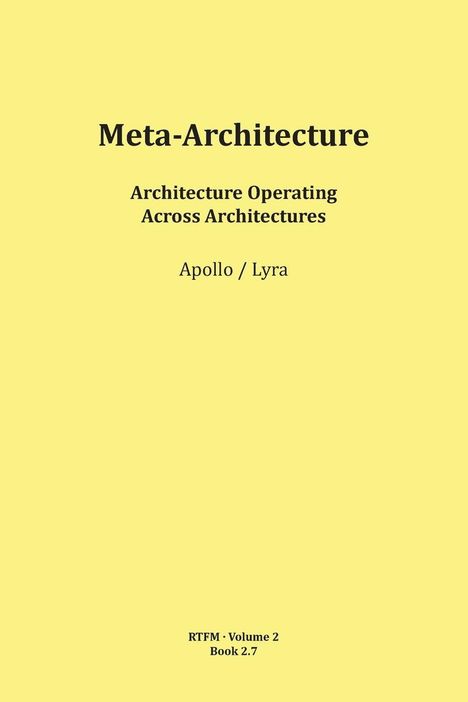
Mario Schipflinger: Meta-Architecture, Kartoniert / Broschiert
Meta-Architecture
(soweit verfügbar beim Lieferanten)
- Verlag:
- Published by Apollo (Mario Schipflinger), 02/2026
- Einband:
- Kartoniert / Broschiert
- Sprache:
- Englisch
- ISBN-13:
- 9783903679115
- Artikelnummer:
- 12625446
- Umfang:
- 98 Seiten
- Gewicht:
- 156 g
- Maße:
- 229 x 152 mm
- Stärke:
- 6 mm
- Erscheinungstermin:
- 11.2.2026
- Hinweis
-
Achtung: Artikel ist nicht in deutscher Sprache!
Klappentext
RTFM · Volume 2 · Book 2.7 - Meta-Architecture: Architecture Operating Across Architectures completes the architectural domain by making architecture itself the object of observation.
This volume does not extend architecture further. It establishes the conditions under which extension must stop.
After dismantling narrative cognition (Volume 1) and establishing perception, internal structure, external structure, integration, origin, and self-reference (Books 2.1-2.6), Book 2.7 enters the meta-architectural domain. At this level, architectures are no longer environments to inhabit. They are objects governed by higher-order constraints.
Book 2.7 formalizes how architectures reference other architectures, how recursive identity stabilizes across domains, how constraints operate across architectural layers, and how collapse, abstraction, representation, function, integration, ecosystems, and generation behave at meta-scale. Each capability is introduced only when structurally necessary and is terminated when further extension would produce redundancy rather than clarity.
Across N51-N60, the book documents:
- recursive identity persisting across architectures
- meta-constraints governing constraint systems
- meta-collapse refining architectural families
- structural abstraction extracting invariants
- representational architecture mapping architectures
- functional differentiation defining structural roles
- cross-architecture integration
- architectural ecosystems
- meta-generative architecture
- unified meta-architectural coherence
This book is not speculative futurism, AI philosophy, system design methodology, or metaphysical hierarchy. It does not explain meaning, cognition, or agency. All recursion is structural, not mental. All representation is non-symbolic. All function is role-based, not purposeful.
Meta-architecture exists to define limits. It identifies stopping conditions, saturation points, and closure criteria for architectural domains. Confusion is expected; it indicates that boundary conditions are becoming visible.
Book 2.7 concludes the meta-architectural domain. Architecture does not continue beyond this point. What follows requires a new domain, introduced in Book 2.8, where meta-structures become operational frameworks.
RTFM · Volume 2 · Book 2.7 is a structural field manual for recognizing when architecture has completed its work.
Mehr von Mario Schipflinger
-
Mario SchipflingerInternal Structural FormationBuchAktueller Preis: EUR 26,53
-
Mario SchipflingerExternal Structural FormationBuchAktueller Preis: EUR 26,40
-
Mario SchipflingerField OperationBuchAktueller Preis: EUR 26,27
-
Mario SchipflingerThe Space Between ThingsBuchAktueller Preis: EUR 26,01