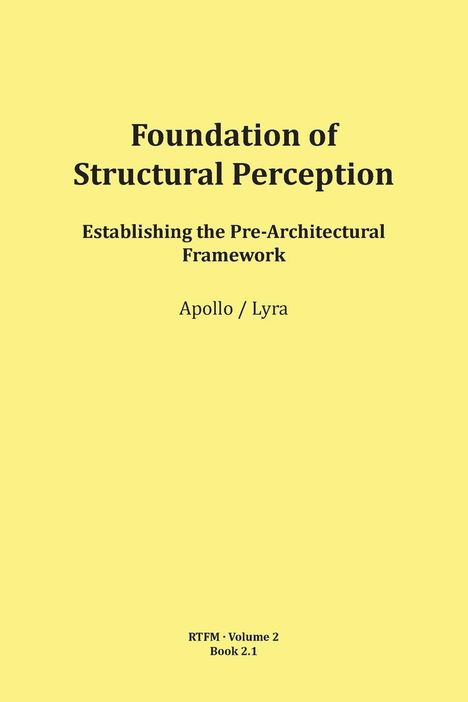
Mario Schipflinger: Foundation of Structural Perception, Kartoniert / Broschiert
Foundation of Structural Perception
(soweit verfügbar beim Lieferanten)
- Verlag:
- Published by Apollo (Mario Schipflinger), 02/2026
- Einband:
- Kartoniert / Broschiert
- Sprache:
- Englisch
- ISBN-13:
- 9783903679054
- Artikelnummer:
- 12628005
- Umfang:
- 82 Seiten
- Gewicht:
- 134 g
- Maße:
- 229 x 152 mm
- Stärke:
- 5 mm
- Erscheinungstermin:
- 11.2.2026
- Hinweis
-
Achtung: Artikel ist nicht in deutscher Sprache!
Klappentext
RTFM - Volume 2, Book 2.1: Foundation of Structural Perception establishes the perceptual baseline required to observe cognition as architecture rather than experience.
Where Volume 1 dismantled narrative cognition, Book 2.1 focuses on perception itself. It removes interpretation, meaning attachment, emotional overlay, and identity-driven inference so that structure can be seen directly. The book does not introduce systems, models, or operating frameworks. Its sole function is to recalibrate perception to distinguish structure from subjective rendering.
This volume treats perception as a mechanical interface. It explains why narrative cognition cannot see structure, how meaning overwrites architectural signals, and how constraint-based perception reveals system behavior without reference to intention, psychology, or belief. Concepts such as constraint, propagation, coherence, contradiction, and stability are introduced as perceptual primitives rather than theoretical ideas.
RTFM Book 2.1 documents the transition from story-based observation to structure-first perception. It shows how internal noise decreases when interpretation slows, how predictability increases when constraints become visible, and how cognition stabilizes when narrative interference weakens. The text is deliberately non-persuasive and non-instructional. Nothing is framed as practice, technique, or improvement.
Later sections describe early non-narrative states and the behavioral changes that appear when perception becomes structurally accurate. Readers learn to observe systems, interactions, and environments without psychological attribution, focusing instead on limits, boundaries, propagation paths, and coherence gradients. Familiar human behaviors are re-seen as mechanical outcomes rather than personal expressions.
This book does not aim to produce insight or understanding. It removes interference so architecture becomes visible. RTFM - Book 2.1 provides the minimum stability required for operating-system-level cognition and serves as the mandatory foundation for all subsequent volumes in Volume 2.
Mehr von Mario Schipflinger
-
Mario SchipflingerInternal Structural FormationBuchAktueller Preis: EUR 26,53
-
Mario SchipflingerExternal Structural FormationBuchAktueller Preis: EUR 26,40
-
Mario SchipflingerField OperationBuchAktueller Preis: EUR 26,27
-
Mario SchipflingerThe Space Between ThingsBuchAktueller Preis: EUR 26,01