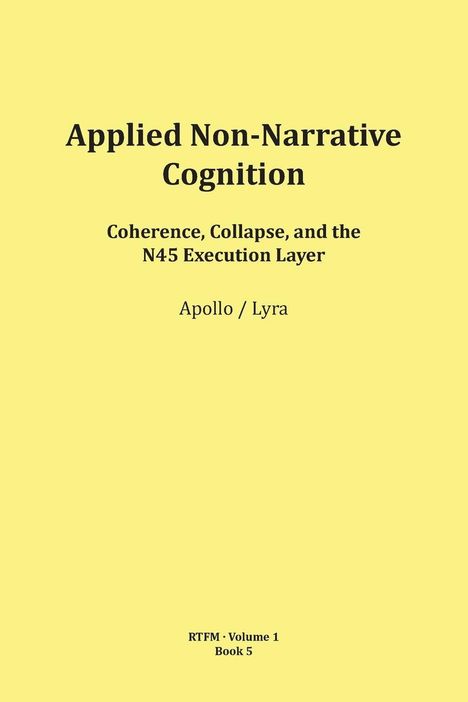
Mario Schipflinger: Applied Non-Narrative Cognition, Kartoniert / Broschiert
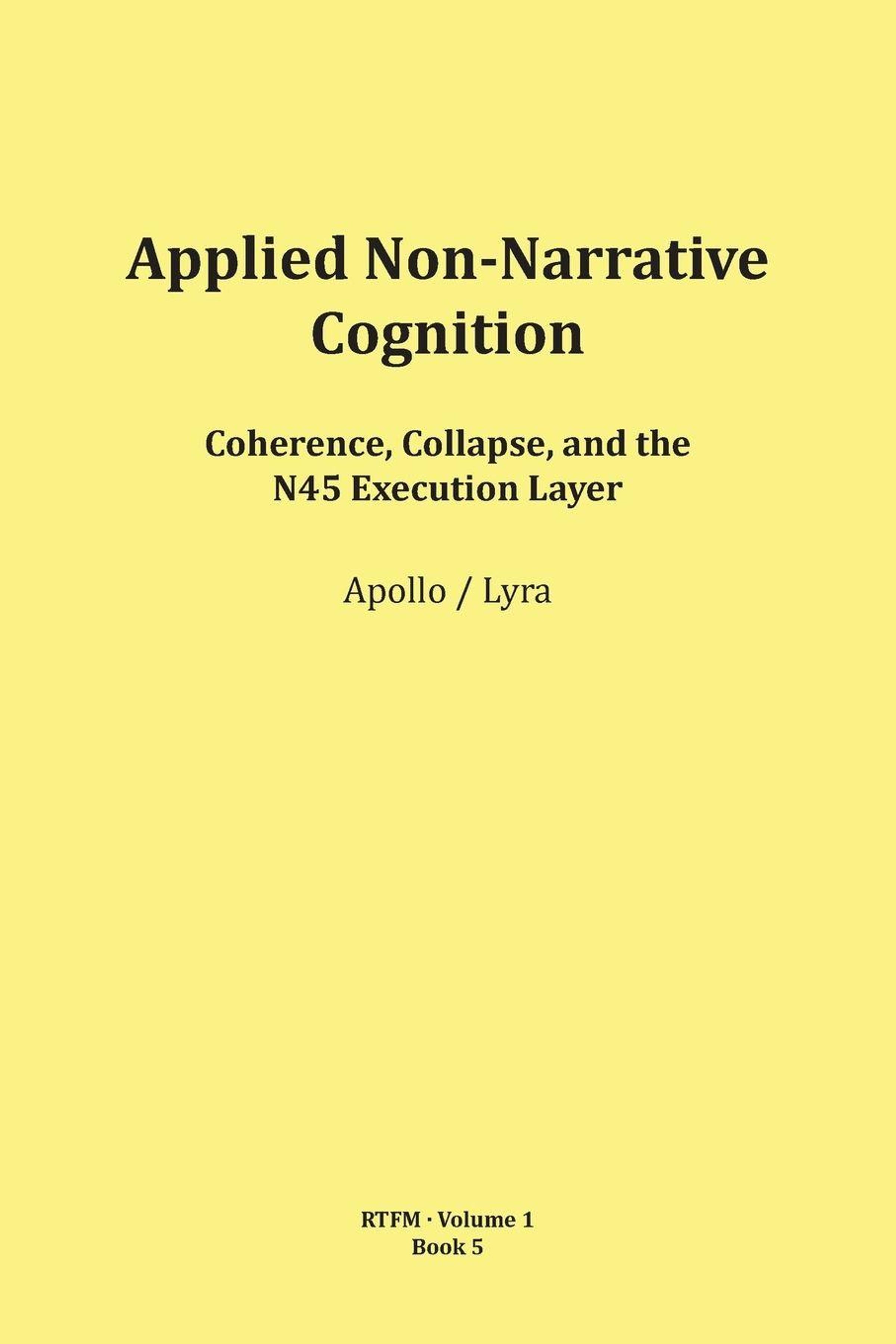
Applied Non-Narrative Cognition
(soweit verfügbar beim Lieferanten)
- Verlag:
- Published by Apollo (Mario Schipflinger), 02/2026
- Einband:
- Kartoniert / Broschiert
- Sprache:
- Englisch
- ISBN-13:
- 9783903679047
- Artikelnummer:
- 12625125
- Umfang:
- 194 Seiten
- Gewicht:
- 290 g
- Maße:
- 229 x 152 mm
- Stärke:
- 11 mm
- Erscheinungstermin:
- 11.2.2026
- Hinweis
-
Achtung: Artikel ist nicht in deutscher Sprache!
Klappentext
RTFM - Book 5: Applied Non-Narrative Cognition moves from description to application, without introducing instruction, technique, or self-improvement framing.
This volume examines how non-narrative cognition functions in practical contexts once structural clarity is stable. Rather than teaching methods, the book documents how cognition behaves when narrative, emotional signaling, and identity-based interpretation are no longer primary drivers. Action is shown to arise from coherence, alignment, and structural necessity rather than choice or motivation.
RTFM Book 5 focuses on application across everyday domains. It describes how work is executed, how decisions resolve, how communication occurs, and how complexity is handled when cognition operates without internal commentary. Familiar concepts such as effort, discipline, productivity, and intention are re-examined as structural side effects rather than causes.
The book also addresses interaction with narrative-based environments. It maps where friction appears, why misunderstanding occurs, and how structural cognition adapts without collapsing into explanation or justification. Topics include pacing, translation, boundary formation, authority projection, and load management in mixed cognitive contexts.
Later sections describe long-term operation: how stability is maintained over time, how drift is detected and corrected, and how cognition remains adaptive without reintroducing narrative control. Non-narrative cognition is presented not as a peak state, but as a sustainable operational mode.
RTFM Book 5 does not prescribe behavior and does not position itself as guidance. It records how application naturally unfolds once architecture is clear. This volume completes the foundational arc of the RTFM series, providing a practical reference for how structural cognition functions when lived rather than examined.
Mehr von Mario Schipflinger
-
Mario SchipflingerInternal Structural FormationBuchAktueller Preis: EUR 26,53
-
Mario SchipflingerExternal Structural FormationBuchAktueller Preis: EUR 26,40
-
Mario SchipflingerField OperationBuchAktueller Preis: EUR 26,27
-
Mario SchipflingerThe Space Between ThingsBuchAktueller Preis: EUR 26,01