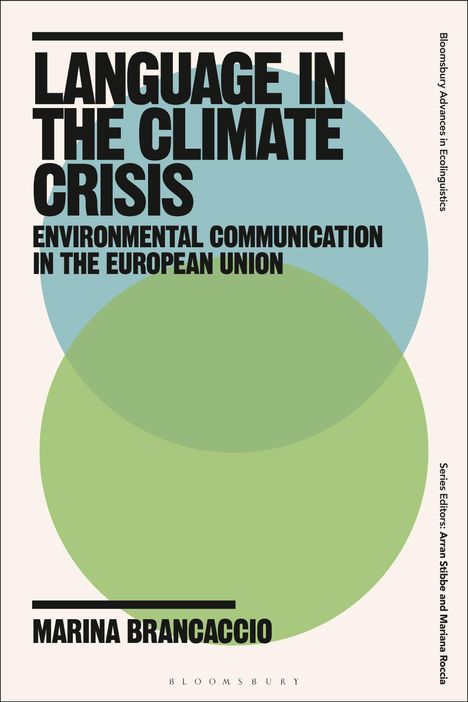
Marina Brancaccio: Language in the Climate Crisis, Gebunden
Language in the Climate Crisis
- Environmental Communication in the European Union
Sie können den Titel schon jetzt bestellen. Versand an Sie erfolgt gleich nach Verfügbarkeit.
- Verlag:
- Bloomsbury Academic, 07/2027
- Einband:
- Gebunden
- Sprache:
- Englisch
- ISBN-13:
- 9781350621039
- Artikelnummer:
- 12760419
- Umfang:
- 296 Seiten
- Gewicht:
- 454 g
- Maße:
- 234 x 156 mm
- Stärke:
- 16 mm
- Erscheinungstermin:
- 8.7.2027
- Hinweis
-
Achtung: Artikel ist nicht in deutscher Sprache!
Klappentext
Language in the Climate Crisis examines how scientific environmental discourse is recontextualised from a global to a regional level to construct legitimacy, authority, and policy narratives in the face of the climate crisis.
Using Corpus-Assisted Critical Discourse Analysis (CACDA), this book investigates how authoritative texts are strategically reshaped to shape ideological positions and mediate the relationship between knowledge and governance within the institutional and political language of the European Union. Drawing insights from discourse studies, linguistics, and environmental communication, the author provides a comparative analysis of global (IPCC) and regional (EEA) scientific reports, alongside a close examination of EU parliamentary speeches and debates. She reveals how political actors engage with and appropriate scientific authority through linguistic strategies such as framing, legitimation, agency, and intertextuality, analysed across a custom-built corpus of over two million words from scientific and political sources.
While the politicisation of climate science is a well-documented phenomenon, little linguistic work has been done on how environmental discourse is used within EU institutional settings, particularly at the micro-textual level. This book exposes the discursive techniques through which science is legitimised, softened, or reframed and foregrounds language as a critical site where climate narratives are shaped, contested, and legitimised. It reveals how discourse is used not only to inform but also to persuade, obscure, or redistribute responsibility in climate governance.