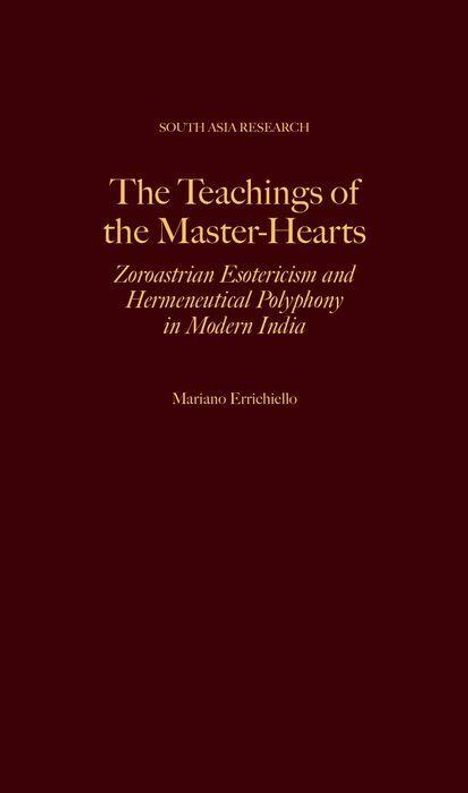
Mariano Errichiello: The Teachings of the Master-Hearts, Gebunden
The Teachings of the Master-Hearts
- Zoroastrian Esotericism and Hermeneutical Polyphony in Modern India
Sie können den Titel schon jetzt bestellen. Versand an Sie erfolgt gleich nach Verfügbarkeit.
- Verlag:
- Oxford University Press, 12/2026
- Einband:
- Gebunden
- Sprache:
- Englisch
- ISBN-13:
- 9780197857564
- Artikelnummer:
- 12696094
- Umfang:
- 224 Seiten
- Erscheinungstermin:
- 8.12.2026
- Hinweis
-
Achtung: Artikel ist nicht in deutscher Sprache!
Klappentext
The Teachings of the Master-Hearts examines the formation, development, and intellectual significance of Ilme K^^num, an esoteric interpretation of Zoroastrianism that emerged among Parsis in modern India. By situating Ilme K^^num within the broader historical context of British colonialism, scientific modernity, revivalist nationalism, and the interconnected Persianate world, Mariano Errichiello presents Parsis as active agents who navigated and reconfigured multiple religious and intellectual currents.
The book combines historical and textual approaches to explore how modern Zoroastrians constructed and contested religious authenticity through diverse interpretive practices. Central to the study is the figure of Behramshah Naoroji Shroff and the esoteric teachings attributed to the "master-hearts" (s^^heb del^^n). Rather than treating Ilme K^^num as a marginal or derivative phenomenon, Errichiello frames it as a distinctive voice within a broader hermeneutical polyphony that characterizes modern Parsi religious thought.
The work is structured in three main parts. The first develops a theoretical framework for the study of the socio-intellectual landscape of colonial India, examining how imperial power, scientific modernity, and revivalist nationalism shaped Parsi religious life. It also advances a conceptual model grounded in relational ontology and hermeneutics to interpret the plurality of religious expressions within the community through an analysis of the spaces and modes in which they are constituted. The second part anchors the study in textual scholarship through an English translation of a key Gujarati text of Ilme K^^num. The third part offers a glossary of technical K^^numic terms (logato), tracing their linguistic and conceptual genealogies across multiple languages and traditions.
Taken together, the book's three sections position Ilme K^^num as a significant site of religious interpretation, challenging binary models and contributing to broader debates on esotericism, modernity, and the dynamics of religious change in South Asia.