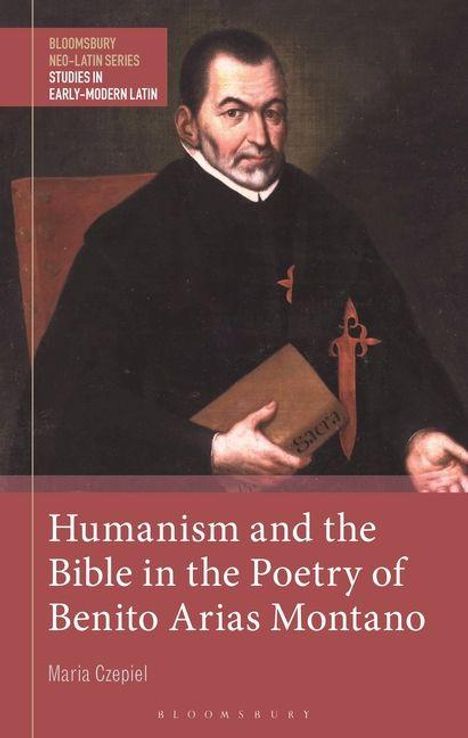
Maria Czepiel: Humanism and the Bible in the Poetry of Benito Arias Montano, Gebunden
Humanism and the Bible in the Poetry of Benito Arias Montano
Sie können den Titel schon jetzt bestellen. Versand an Sie erfolgt gleich nach Verfügbarkeit.
- Herausgeber:
- Gesine Manuwald, Stephen Harrison, William M Barton, Bobby Xinyue
- Verlag:
- Bloomsbury Publishing plc, 12/2026
- Einband:
- Gebunden
- Sprache:
- Englisch
- ISBN-13:
- 9781350497634
- Artikelnummer:
- 12621780
- Umfang:
- 256 Seiten
- Gewicht:
- 454 g
- Maße:
- 234 x 156 mm
- Stärke:
- 25 mm
- Erscheinungstermin:
- 10.12.2026
- Hinweis
-
Achtung: Artikel ist nicht in deutscher Sprache!
Klappentext
**This open-access book fills a gap in our understanding of the religious poetry of sixteenth-century Spain by arguing for a new significance to the poetry of one of its central figures.**The Latin poetry of cleric, scholar, librarian and political advisor Benito Arias Montano escaped censorship inspired by the 1559 Valdés Index, and so provides a unique window into the development of religious poetry in the late sixteenth century between Renaissance biblical paraphrase and the advent of Baroque religious poetry.
Although Arias Montano was a true Renaissance polymath, learned in disciplines ranging from philology to natural philosophy, his interest in emerging humanist disciplines had to be balanced with his convictions that the Bible was the only source of true knowledge. Part One of this study presents an overview of his work and compares this with other religious poets writing across Europe. Czepiel argues that this scholar, a Spanish Catholic of the sixteenth century, is an early exponent of a European trend which sought to apply an encyclopaedic range of humanist disciplines to the study of the Bible, something which was previously attributed to the later seventeenth-century Protestant Republic of Letters. Part Two comprises case studies of particular scholarly disciplines within Arias Montano's poetry, including the study of Classical texts, Hebraist studies, historiography and political theory, and biblical geography and architecture. In each case, Czepiel argues for the poetry betraying a clear anxiety about the limitations and proper use of humanist scholarship.
The ebook editions of this book are available open access under a CC BY-NC-ND 4.0 licence on bloomsburycollections. com. Open access was funded by Arts and Humanities Research Council (AHRC).