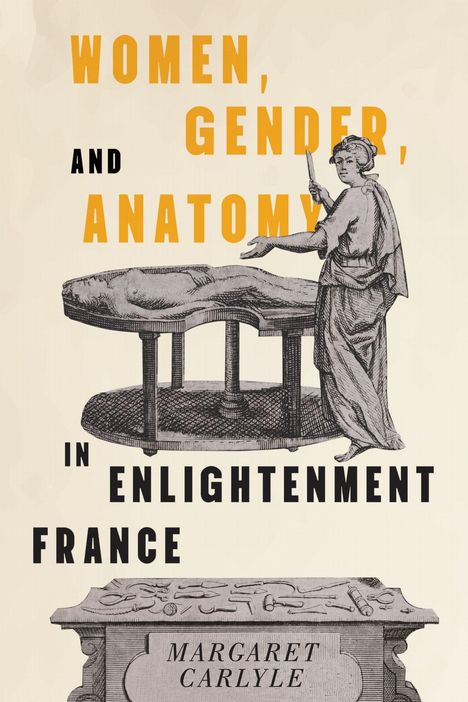
Margaret Carlyle: Women, Gender, and Anatomy in Enlightenment France, Gebunden
Women, Gender, and Anatomy in Enlightenment France
Sie können den Titel schon jetzt bestellen. Versand an Sie erfolgt gleich nach Verfügbarkeit.
- Verlag:
- McGill-Queen's University Press, 12/2026
- Einband:
- Gebunden
- Sprache:
- Englisch
- ISBN-13:
- 9780228028833
- Artikelnummer:
- 12639499
- Umfang:
- 464 Seiten
- Erscheinungstermin:
- 15.12.2026
- Serie:
- McGill-Queen's/AMS Healthcare Studies in the History of Medicine, Health, and Society
- Hinweis
-
Achtung: Artikel ist nicht in deutscher Sprache!
Klappentext
By the mid-eighteenth century, anatomy was one of medicine's most dynamic fields, dominated by men but reliant on women's bodies and knowledge. This dependence gave women a complicated and often overlooked role in the development of modern medicine.
Women, Gender, and Anatomy in Enlightenment France reveals how the dissection, study, and representation of female bodies became central to the professional training and social authority of medical practitioners, transforming anatomy into both a scientific enterprise and a performance of expertise. Margaret Carlyle demonstrates how women shaped anatomical culture not only as objects of study but also as educators, entrepreneurs, and practitioners working alongside male surgeons and physicians. She argues that this participation reflected a broader feminization of anatomy, marked by a growing fascination with women's reproductive bodies, the rise of lifelike female anatomical models in wax and plaster, and the specialized training of surgeons and midwives. Women contributed directly to anatomical practice through dissection, modelling, illustration, and teaching, as seen in the careers of Marie-Marguerite Biheron and Marie-Geneviève-Charlotte Thiroux d'Arconville. Yet even as women participated across arenas of anatomical knowledge production -- from classrooms and amphitheatres to museums, print culture, and workshops -- their involvement remained controversial and their contributions marginalized.
By placing women's bodies and labour at the heart of eighteenth-century medical science in France, this history presents a gendered rethinking of the origins of modern anatomy.