Saira Mirza: The Psychology of South Asian Shame: Mapping Caste, Colonial & Intergenerational Trauma..., Gebunden
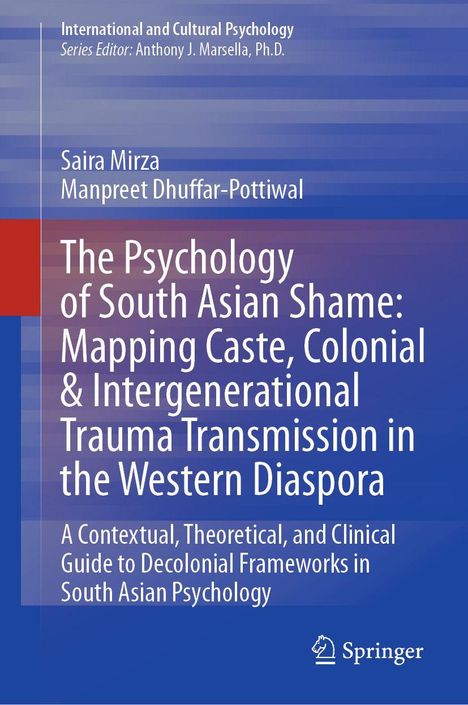
The Psychology of South Asian Shame: Mapping Caste, Colonial & Intergenerational Trauma Transmission in the Western Diaspora
- A Contextual, Theoretical, and Clinical Guide to Decolonial Frameworks in South Asian Psychology
(soweit verfügbar beim Lieferanten)
- Verlag:
- Springer, 05/2026
- Einband:
- Gebunden
- Sprache:
- Englisch
- ISBN-13:
- 9783032166715
- Artikelnummer:
- 12674916
- Umfang:
- 228 Seiten
- Gewicht:
- 510 g
- Maße:
- 241 x 160 mm
- Stärke:
- 18 mm
- Erscheinungstermin:
- 15.5.2026
- Serie:
- International and Cultural Psychology
- Hinweis
-
Achtung: Artikel ist nicht in deutscher Sprache!
Klappentext
This book reveals shame as a political, biological, and cultural inheritance, an architecture of feeling and power that silently shapes identity, belonging, and survival across South Asian diasporas.
At its core, it reframes shame through five interwoven characteristics: polarisation, hierarchy, intersectionality, weaponisation, and neuroticism, revealing how shame functions both as an emotional wound and a system of social control. It divides communities through caste and intragroup conflict; institutionalises inequality by assigning worth at birth; compounds harm through gender, colourism, class, and religion; and is wielded by dominant groups to maintain power. Internalised shame renders superiority and inferiority natural, even moral, turning difference into danger and kin into adversaries.
Drawing on historical analysis, psychological theory, and cultural narrative, the book shows how shame becomes embedded in the nervous system, carried across generations, and sustained by a conspiracy of silence. Colonialism, Partition, migration, and racism shape inner worlds, producing relational wounds that continue to define South Asian families, communities, and diasporic identities.
Introducing a suite of frameworks, the book offers culturally grounded psychological tools:
• South Asian Typology of Attachment: how early caregiving is shaped by intergenerational shame, duty, honour, caste, and emotional suppression. • South Asian Ecological Systems theory: how trauma is transmitted through family dynamics, community expectations, caste structures, and ancestral trauma. • South Asian Acculturation theory: how identity and belonging are negotiated across borders. • Caste Trauma Transmission Model: how caste, patriarchy, supremacism, and capitalism reproduce trauma and shame across generations. • South Asian Shame Model: revealing shame as a central organising principle of emotional and relational life, shaping behaviour and culturally patterned psychopathology.
Together, these frameworks move beyond Eurocentric psychology to offer a transformative account of the South Asian psyche. Ultimately, the book calls for breaking silences, challenging hierarchies, and imagining futures grounded in compassion, dignity, justice, and equity.
Mehr von Saira Mirza
-
Migration Psychology, Volume IIBuchVorheriger Preis EUR 190,83, reduziert um 0%Aktueller Preis: EUR 170,69
-
Migration Psychology, Volume IBuchAktueller Preis: EUR 170,69
-
Migration Psychology, Volume IIBuchVorheriger Preis EUR 190,83, reduziert um 0%Aktueller Preis: EUR 170,69
-
Migration Psychology, Volume IBuchAktueller Preis: EUR 170,69