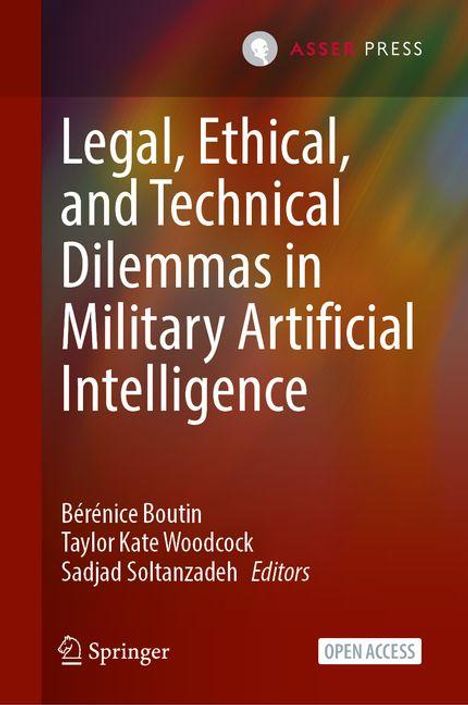
Legal, Ethical, and Technical Dilemmas in Military Artificial Intelligence, Gebunden
Legal, Ethical, and Technical Dilemmas in Military Artificial Intelligence

(soweit verfügbar beim Lieferanten)
- Herausgeber:
- Bérénice Boutin, Taylor Kate Woodcock, Sadjad Soltanzadeh
- Verlag:
- T.M.C. Asser Press, 04/2026
- Einband:
- Gebunden
- Sprache:
- Englisch
- ISBN-13:
- 9789462657588
- Artikelnummer:
- 12558350
- Umfang:
- 352 Seiten
- Gewicht:
- 667 g
- Maße:
- 234 x 156 mm
- Stärke:
- 21 mm
- Erscheinungstermin:
- 8.4.2026
- Hinweis
-
Achtung: Artikel ist nicht in deutscher Sprache!
Klappentext
This open access book explores the multifaceted implications of military AI across a broad spectrum of applications, including autonomous weapon systems, decision-support technologies, and AI-augmented human capabilities. Building on the work of the DILEMA project on Designing International Law and Ethics into Military Artificial Intelligence, this book critically examines how AI reshapes core concepts such as agency, responsibility, and control. It identifies the need for innovative governance mechanisms, ethically-informed technical design, robust frameworks for legal compliance and accountability, and clearly articulated normative limitations to the use of AI.
By bridging disciplines such as international law, philosophy of technology, science and technology studies, cognitive and behavioural science, international relations, systems engineering, and computer science, this volume offers an essential contribution to understanding how AI is reconfiguring the principles and practices of modern warfare. Designed for scholars, policymakers, military professionals, and technologists, this book provides cutting-edge insights into the promises and perils of military AI and proposes pathways for responsible integration of these transformative technologies.
Bérénice Boutin is affiliated to the T. M.C. Asser Instituut in the Hague, The Netherlands and the University of Amsterdam, The Netherlands; Taylor Kate Woodcock is affiliated to the T. M.C. Asser Instituut in the Hague, The Netherlands and the University of Amsterdam, The Netherlands; and Sadjad Soltanzadeh is affiliated to the Philosophy Department of the University of Twente, Enschede, The Netherlands.