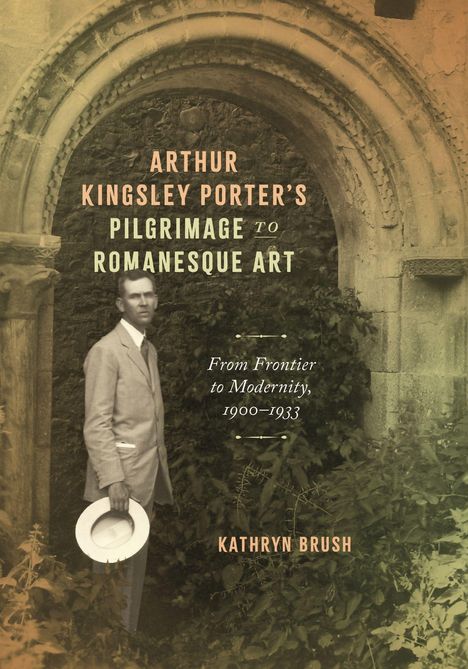
Kathryn Brush: Arthur Kingsley Porter's Pilgrimage to Romanesque Art, Gebunden
Arthur Kingsley Porter's Pilgrimage to Romanesque Art
- From Frontier to Modernity, 1900-1933
Sie können den Titel schon jetzt bestellen. Versand an Sie erfolgt gleich nach Verfügbarkeit.
- Verlag:
- McGill-Queen's University Press, 01/2027
- Einband:
- Gebunden
- Sprache:
- Englisch
- ISBN-13:
- 9780228028888
- Artikelnummer:
- 12798045
- Umfang:
- 576 Seiten
- Erscheinungstermin:
- 12.1.2027
- Hinweis
-
Achtung: Artikel ist nicht in deutscher Sprache!
Klappentext
The author of trailblazing studies of medieval art and a globetrotter who vanished in Ireland, Harvard scholar Arthur Kingsley Porter (1883--1933) remains a legendary figure. A century ago Porter and his wife, Lucy Wallace Porter, crossed the Atlantic and enlisted the modern car and camera to redraw the cultural map of medieval Europe. His landmark Romanesque Sculpture of the Pilgrimage Roads , illustrated with her photographs of eleventh- and twelfth-century sites, catapulted the medieval pilgrimage routes to Santiago de Compostela to international fame and influenced collecting at European and American museums.
In this groundbreaking new work Kathryn Brush situates Porter's medievalism within his eventful life and shows that his North American experiences -- including previously undocumented journeys into Canada's wilderness -- were central to the formation of his ideas and aesthetic vision. Drawing from thousands of unstudied archival and photographic sources, Brush reconstructs Porter's work, travels, and intellectual development. She argues that Porter's explorations of the North American frontier shaped his attraction to Europe's peripheries, while his engagement with American writers, artists, and architects, his ambivalent modernism, and his reliance on Wallace Porter's photographic practice inflected his interpretations of medieval art and architecture. Immersive, interdisciplinary, and non-linear, Porter's highly individualistic and image-centric approach resisted convention, advocating for an understanding of artistic form beyond narrow nationalistic, historical, and cultural categories. Both intellectual history and biography, the book examines how Porter's fascination with "wild Romanesque" intersected with his midlife recognition of his homosexuality.
Using profound original research and historical analysis to relate a story of adventure, scholarly discovery, deep partnerships, and heartbreak, this richly illustrated book revises and expands our view of an extraordinary scholar, challenging us to reconsider how modern knowledge about an imagined historical past is created and received.