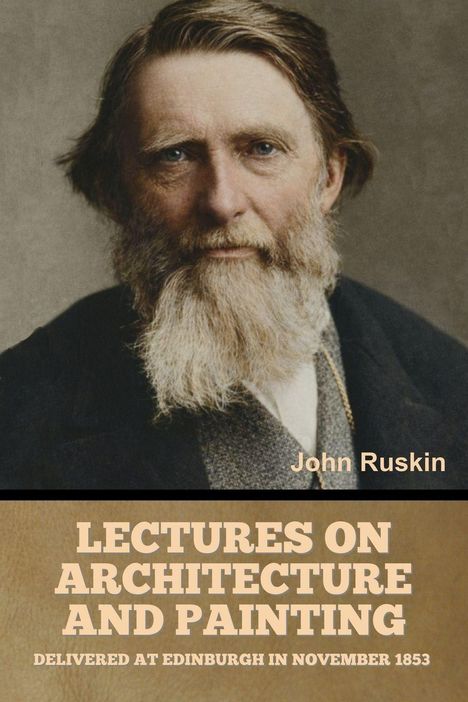
John Ruskin: Lectures on Architecture and Painting, Delivered at Edinburgh in November 1853, Kartoniert / Broschiert
Lectures on Architecture and Painting, Delivered at Edinburgh in November 1853
(soweit verfügbar beim Lieferanten)
- Verlag:
- IndoEuropeanPublishing.com, 02/2026
- Einband:
- Kartoniert / Broschiert
- Sprache:
- Englisch
- ISBN-13:
- 9798889425786
- Artikelnummer:
- 12625603
- Umfang:
- 130 Seiten
- Gewicht:
- 223 g
- Maße:
- 229 x 152 mm
- Stärke:
- 8 mm
- Erscheinungstermin:
- 13.2.2026
- Hinweis
-
Achtung: Artikel ist nicht in deutscher Sprache!
Klappentext
John Ruskin's Lectures on Architecture and Painting, Delivered at Edinburgh in November 1853 present a passionate defense of art as a moral and spiritual force in society. Ruskin argues that architecture and painting are not merely decorative or technical pursuits, but expressions of a nation's character and values. He believes that true art reflects the moral health of the people who create it. For Ruskin, beauty is closely connected to truth and goodness; therefore, artists and architects have a responsibility to pursue honesty in their work. He criticizes the growing industrialization of the nineteenth century, suggesting that mechanization and mass production weaken both craftsmanship and the human spirit.
In the lectures, Ruskin emphasizes the importance of Gothic architecture as a model of artistic and moral integrity. He admires Gothic buildings because they reveal the individuality and freedom of the craftsmen who created them. Unlike classical architecture, which he sees as rigid and overly focused on perfection, Gothic architecture allows for variation and imperfection, reflecting the humanity of the worker. Ruskin views this freedom as essential to meaningful artistic creation. He also discusses painting, particularly praising artists who remain faithful to nature. He argues that artists should carefully observe and represent the natural world, as nature is a manifestation of divine truth.
Ultimately, Ruskin's lectures call for a return to sincerity, craftsmanship, and moral purpose in the arts. He warns that societies which neglect the spiritual and ethical dimensions of art risk cultural decline. By linking artistic practice to broader social and moral concerns, Ruskin elevates architecture and painting beyond aesthetic enjoyment. His ideas influenced later movements such as the Arts and Crafts Movement, which sought to restore dignity to labor and design. Through these lectures, Ruskin challenges his audience to recognize art as a powerful force shaping both individual character and national identity.
About the Author
John Ruskin (1819-1900) was a leading English art critic, writer, and social thinker of the Victorian era. Born in London to a prosperous wine merchant, Ruskin was educated privately and later attended the University of Oxford. From an early age he showed a deep appreciation for art and nature, interests that would shape his life's work. His eloquent prose and passionate beliefs made him one of the most influential cultural figures of the nineteenth century.
Ruskin first gained widespread recognition with the publication of Modern Painters (1843-1860), a multi-volume work in which he defended the painter J. M.W. Turner and argued that artists should remain faithful to nature. He believed that art should express truth and moral purpose rather than merely imitate classical traditions. His ideas challenged established academic standards and helped elevate landscape painting to greater prominence in Britain. Ruskin's criticism combined detailed observation with broader reflections on beauty, imagination, and spirituality.
Beyond art criticism, Ruskin became an outspoken social critic. In works such as Unto This Last (1860) and Sesame and Lilies (1865), he attacked industrial capitalism and argued that economic systems should prioritize human well-being over profit. He was deeply troubled by the social inequalities and environmental damage brought about by industrialization. His social philosophy influenced later reformers, including Mahatma Gandhi, and contributed to movements advocating for social justice and improved working conditions. ...