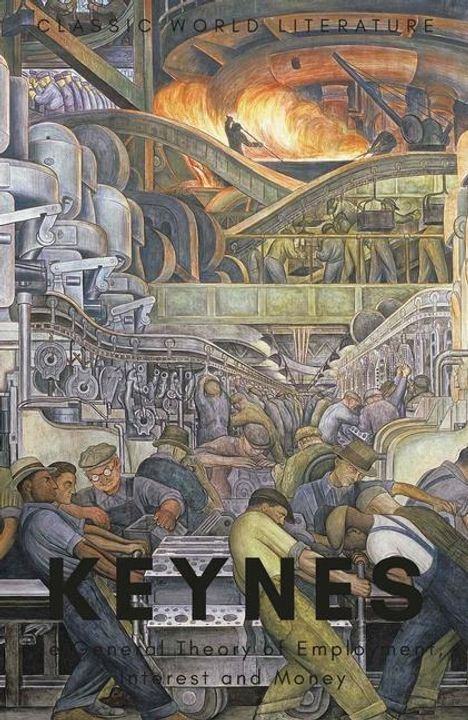
John Maynard Keynes: The General Theory of Employment, Interest and Money, Kartoniert / Broschiert
The General Theory of Employment, Interest and Money
- with The Economic Consequences of the Peace
(soweit verfügbar beim Lieferanten)
- Verlag:
- Wordsworth Editions Ltd, 03/2017
- Einband:
- Kartoniert / Broschiert, ,
- Sprache:
- Englisch
- ISBN-13:
- 9781840227475
- Artikelnummer:
- 6604605
- Umfang:
- 576 Seiten
- Gewicht:
- 363 g
- Maße:
- 195 x 126 mm
- Stärke:
- 32 mm
- Erscheinungstermin:
- 5.3.2017
- Serie:
- Classics of World Literature
- Hinweis
-
Achtung: Artikel ist nicht in deutscher Sprache!
Weitere Ausgaben von The General Theory of Employment, Interest and Money |
Preis |
|---|
Klappentext
John Maynard Keynes (1883-1946) is perhaps the foremost economic thinker of the twentieth century. On economic theory, he ranks with Adam Smith and Karl Marx; and his impact on how economics was practiced, from the Great Depression to the 1970s, was unmatched.
The General Theory of Employment, Interest and Money was first published in 1936. But its ideas had been forming for decades ? as a student at Cambridge, Keynes had written to a friend of his love for 'Free Trade and free thought'. Keynes's limpid style, concise prose, and vivid descriptions have helped to keep his ideas alive - as have the novelty and clarity, at times even the ambiguity, of his macroeconomic vision. He was troubled, above all, by high unemployment rates and large disparities in wealth and income. Only by curbing both, he thought, could individualism, 'the most powerful instrument to better the future', be safeguarded. The twenty-first century may yet prove him right.
In The Economic Consequences of the Peace (1919), Keynes elegantly and acutely exposes the folly of imposing austerity on a defeated and struggling nation.
Biografie
Keynes, John M. was born in Cambridge in 1883, son of John Neville Keynes, later registrary of the university; his mother was one of the earliest women students. Educated at Eton and King's, he passed into the Civil Service in 1906, working for three years in the India office. He returned to Cambridge as a Fellow of King's in 1909 and remained a Fellow until his death.