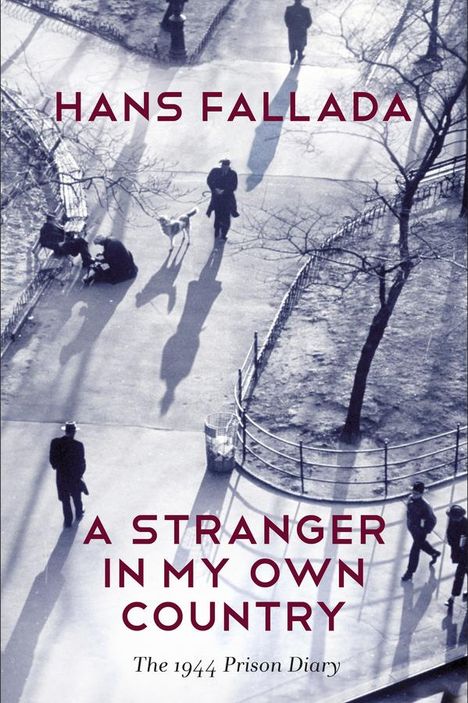
Hans Fallada: A Stranger in My Own Country, Gebunden
A Stranger in My Own Country
- The 1944 Prison Diary
(soweit verfügbar beim Lieferanten)
- Übersetzung:
- Allan Blunden
- Verlag:
- Polity Press, 12/2014
- Einband:
- Gebunden, ,
- Sprache:
- Englisch
- ISBN-13:
- 9780745669885
- Artikelnummer:
- 4236879
- Umfang:
- 300 Seiten
- Copyright-Jahr:
- 2015
- Gewicht:
- 569 g
- Maße:
- 236 x 161 mm
- Stärke:
- 35 mm
- Erscheinungstermin:
- 15.12.2014
- Hinweis
-
Achtung: Artikel ist nicht in deutscher Sprache!
Klappentext
'I lived the same life as everyone else, the life of ordinary people, the masses.' Sitting in a prison cell in the autumn of 1944, Hans Fallada sums up his life under the National Socialist dictatorship, the time of 'inward emigration'. Under conditions of close confinement, in constant fear of discovery, he writes himself free from the nightmare of the Nazi years. His frank and sometimes provocative memoirs were thought for many years to have been lost. They are published here in English for the first time.
The confessional mode did not come naturally to Fallada the writer of fiction, but in the mental and emotional distress of 1944, self-reflection became a survival strategy. In the 'house of the dead' he exacts his political revenge on paper. 'I know that I am crazy. I'm risking not only my own life, I'm also risking ... the lives of many of the people I am writing about', he notes, driven by the compulsion to write. And write he does - about spying and denunciation, about the threat to his livelihood and his literary work, about the fate of many friends and contemporaries such as Ernst Rowohlt and Emil Jannings. To conceal his intentions and to save paper, he uses abbreviations. His notes, constantly exposed to the gaze of the prison warders, become a kind of secret code. He finally succeeds in smuggling the manuscript out of the prison, although it remained unpublished for half a century.
These revealing memoirs by one of the best-known German writers of the 20th century will be of great interest to all readers of modern literature.
Biografie (Hans Fallada)
Rudolf Ditzen alias Hans Fallada , geb. 1893 in Greifswald als Sohn eines hohen Justizbeamten, besuchte ohne Abschluss das humanistische Gymnasium und absolvierte eine landwirtschaftliche Lehre. Von 1915-25 war er Rendant auf Rittergütern, Hofinspektor, Buchhalter, von 1928-31 Adressenschreiber, Annoncensammler, Verlagsangestellter. 1920 Roman-Debüt 'Der junge Goedeschal', seit 1931 freiberuflicher Schriftsteller. Mit dem vielfach übersetzten Roman 'Kleiner Mann was nun?' (1932) wurde Fallada weltbekannt. In der Zeit des Faschismus lebte er als 'unerwünschter Autor' zurückgezogen auf seinem Sechs-Morgen-Anwesen in Mecklenburg. 1945 siedelte er nach Berlin über und starb dort 1947.§Weitere wichtige Werke: 'Bauern, Bonzen und Bomben' (1931), 'Wer einmal aus dem Blechnapf frißt' (1934), 'Wolf unter Wölfen' (1937), 'Der eiserne Gustav' (1938), 'Geschichten aus der Murkelei' (1938), 'Jeder stirbt für sich allein' (1947).