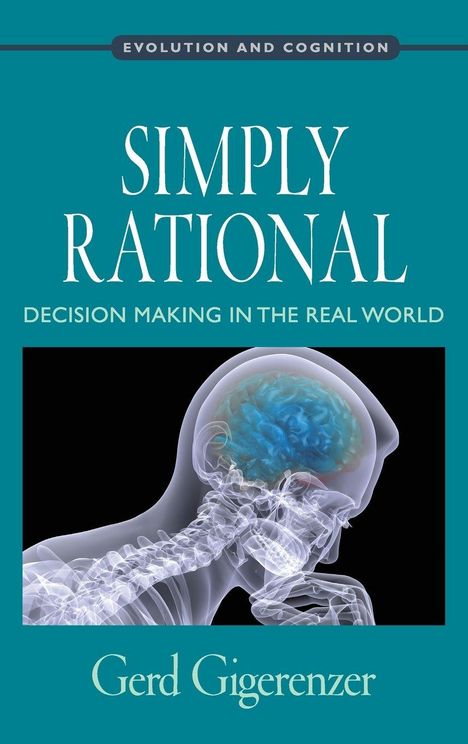
Gerd Gigerenzer: Simply Rational, Gebunden
Simply Rational
- Decision Making in the Real World
(soweit verfügbar beim Lieferanten)
- Verlag:
- OXFORD UNIV PR, 03/2015
- Einband:
- Gebunden
- Sprache:
- Englisch
- ISBN-13:
- 9780199390076
- Artikelnummer:
- 6733326
- Umfang:
- 326 Seiten
- Gewicht:
- 596 g
- Maße:
- 244 x 161 mm
- Stärke:
- 25 mm
- Erscheinungstermin:
- 31.3.2015
- Hinweis
-
Achtung: Artikel ist nicht in deutscher Sprache!
Klappentext
Statistical illiteracy can have an enormously negative impact on decision making. This volume of collected papers brings together applied and theoretical research on risks and decision making across the fields of medicine, psychology, and economics. Collectively, the essays demonstrate why the frame in which statistics are communicated is essential for broader understanding and sound decision making, and that understanding risks and uncertainty has wide-reaching implications for daily life. Gerd Gigerenzer provides a lucid review and catalog of concrete instances of heuristics, or rules of thumb, that people and animals rely on to make decisions under uncertainty, explaining why these are very often more rational than probability models. After a critical look at behavioral theories that do not model actual psychological processes, the book concludes with a call for a "heuristic revolution" that will enable us to understand the ecological rationality of both statistics and heuristics, and bring a dose of sanity to the study of rationality.
Biografie
Gerd Gigerenzer ist der in Wissenschaftskreisen derzeit meistzitierte deutsche Psychologe. Nach Lehrtätigkeiten in Konstanz, Salzburg und Chicago ist er heute Direktor am Max-Planck-Institut für Bildungsforschung in Berlin, wo er den Bereich Adaptives Verhalten und Kognition leitet. Dort erforscht er u. a. Risikoverhalten und -kommunikation, die Natur sozialer Intelligenz und schließlich, wie Menschen mit begrenzter Zeit und begrenztem Wissen Entscheidungen treffen. Seine Forschungsarbeit ist interdisziplinär und berührt die Fachrichtungen Ökonomie, Informatik, Psychologie, Mathematik, Anthropologie und Biologie.§Er hat zahlreiche internationale Auszeichnungen erhalten, so auch den Preis der renommierten American Association for the Advancement of Science (AAAS)