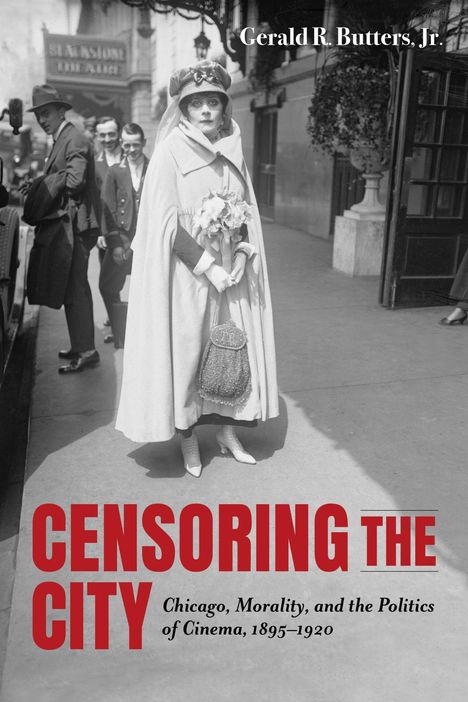
Gerald R Butters: Censoring the City, Gebunden
Censoring the City
- Chicago, Morality, and the Politics of Cinema, 1895-1920
Lassen Sie sich über unseren eCourier benachrichtigen, sobald das Produkt bestellt werden kann.
- Verlag:
- Indiana University Press, 06/2027
- Einband:
- Gebunden
- Sprache:
- Englisch
- ISBN-13:
- 9780253078452
- Umfang:
- 336 Seiten
- Gewicht:
- 572 g
- Erscheinungstermin:
- 22.6.2027
- Hinweis
-
Achtung: Artikel ist nicht in deutscher Sprache!
Weitere Ausgaben von Censoring the City |
Preis |
|---|---|
| Buch, Kartoniert / Broschiert, Englisch | EUR 55,57* |
Ähnliche Artikel


Klappentext
Censoring the City explores the intimate ties between motion picture censorship in Chicago and political power during the Progressive era, beginning with the earliest attempts to control penny arcades and peep shows in the mid-1890s.
While the Chicago Police Department oversaw motion picture censorship from its origins, they were never truly in control of it; rather, various social and religious organizations in the city pressured Democratic and Republican mayors to censor materials they thought were offensive. These Progressive reformers, many of whom were women, believed that motion pictures and the theaters that exhibited them needed censorship to protect children from becoming criminals or morally loose--but there was also a nativist quality to these attempts, and racial, ethnic, and religious characterizations, as well as a push for neutrality during World War I, further challenged the boundaries of what would be accepted on screen. "Obscenity" and "immorality" proved difficult for the censorship board to define, however, and theater owners, distributors, and movie studios consistently contested censorship of their entertainment by the government. Black Chicagoans demonstrated real agency during this era as well, both as members of the Chicago Censor Board and as activists, self-censoring racial imagery.
Offering the first comprehensive history of motion picture censorship in turn-of-the-century Chicago, Censoring the City illustrates how motion picture content and the theaters that exhibited them were directly connected to municipal politics, which the city's mayors ignored at their own political peril.