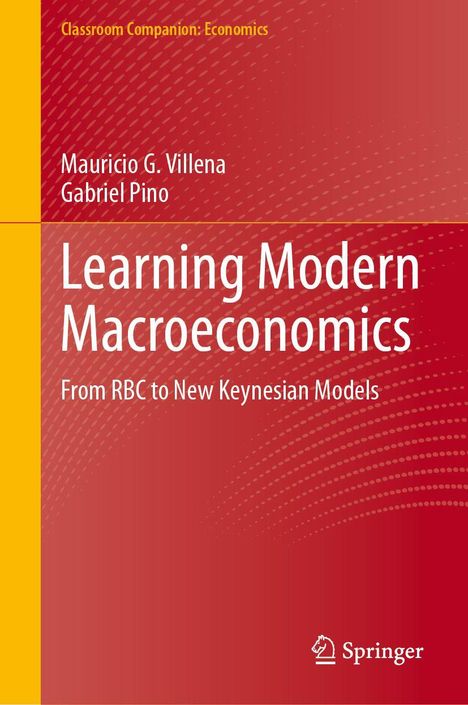
Gabriel Pino: Learning Modern Macroeconomics, Gebunden
Learning Modern Macroeconomics
- From RBC to New Keynesian Models
Sie können den Titel schon jetzt bestellen. Versand an Sie erfolgt gleich nach Verfügbarkeit.
- Verlag:
- Springer Nature Switzerland AG, 11/2026
- Einband:
- Gebunden
- Sprache:
- Englisch
- ISBN-13:
- 9783032314628
- Artikelnummer:
- 12906902
- Umfang:
- 394 Seiten
- Erscheinungstermin:
- 19.11.2026
- Serie:
- Classroom Companion: Economics
- Hinweis
-
Achtung: Artikel ist nicht in deutscher Sprache!
Klappentext
Modern macroeconomics, as practiced in academic research and central banks, rests on microfoundations that explain aggregate outcomes through the optimizing behavior of households and firms. Yet students often face a sharp divide between intuitive demandside models and the full technical apparatus of infinitehorizon DSGE frameworks. This book closes this gap.
The book is built around a deliberately compact and transparent laboratory: twöperiod dynamic generalequilibrium models with closedform solutions. By keeping every assumption, constraint, shadow price, and firstorder condition explicitly on the page, it allows readers to derive the transmission mechanisms of monetary and fiscal policy themselves rather than treating them as black boxes. Heavy dynamic programming and numerical methods are avoided so that the core economic logic remains fully visible throughout.
The exposition develops systematically from microeconomic foundations---consumption and saving, labor supply, investment, and general equilibrium---to a sequence of cumulative policy applications. A flexibleprice RBC benchmark establishes monetary neutrality, followed by cashinadvance and New Keynesian environments that introduce nominal rigidities, the zero lower bound, and monetary--fiscal interactions. Fiscal policy, heterogeneity through a TwöAgent New Keynesian (TANK) model, and international macroeconomics in openeconomy and twöcountry settings are all treated analytically within the same unified framework.
The final part bridges the twöperiod approach to infinitehorizon DSGE models, deriving the canonical threeequation New Keynesian model in full and providing readytörun Dynare files for immediate simulation. Designed as a selfcontained onesemester textbook, the volume is modular, exercisebased, and analytically rigorous, equipping readers with a clear and reliable pathway into contemporary macroeconomic research and policy analysis.