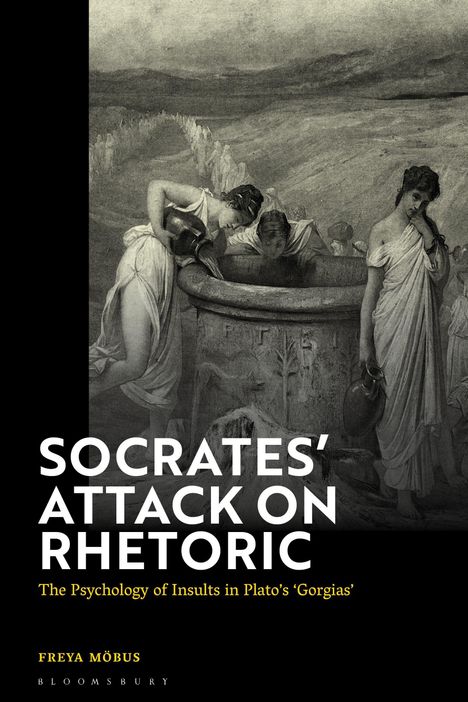
Freya Möbus: Socrates' Attack on Rhetoric, Gebunden
Socrates' Attack on Rhetoric
- The Psychology of Insults in Plato's 'Gorgias'
Sie können den Titel schon jetzt bestellen. Versand an Sie erfolgt gleich nach Verfügbarkeit.
- Verlag:
- Bloomsbury Academic, 01/2027
- Einband:
- Gebunden
- Sprache:
- Englisch
- ISBN-13:
- 9781350592360
- Artikelnummer:
- 12760735
- Umfang:
- 224 Seiten
- Gewicht:
- 454 g
- Maße:
- 234 x 156 mm
- Stärke:
- 14 mm
- Erscheinungstermin:
- 21.1.2027
- Hinweis
-
Achtung: Artikel ist nicht in deutscher Sprache!
Klappentext
In Plato's Gorgias, Socrates attacks rhetoricians harshly. In this groundbreaking book, Freya Möbus argues that Socrates is not merely harsh but deliberately insulting-an insight that opens up a bold new reading of Plato's dialogue.
Through extensive historical and linguistic research, Möbus brings Socrates' insults of the rhetorician as a kolax , opsopoios , and kinaidos back to life. Against standard readings of these terms as flatterer, pastry chef, and catamite, she shows that Socrates in fact uses ancient Greek stock insults to criticize the rhetorician for his disingenuous performance of friendship, which nourishes intemperance and disorder in the individual, the community, and even the cosmos. To Socrates, rhetoricians are wrongdoers in need of correction, and this is precisely what he sets out to do. Continuing her original argument, Möbus contends that Socrates puts the rhetorician on trial in the Gorgias for two reasons: to psychologically benefit the audience, showing them, in a humorous way, that they themselves have fallen victim to rhetoric, and to prosecute the rhetorician, using insult as a tool of philosophical reform.
By taking Socrates' words as precisely what they are - insulting speech - and uncovering their true cultural and philosophical meaning, Socrates' Attack on Rhetoric transforms our understanding not only of Socrates' case against rhetoric, but also of his psychology of correction and his practice of philosophy.