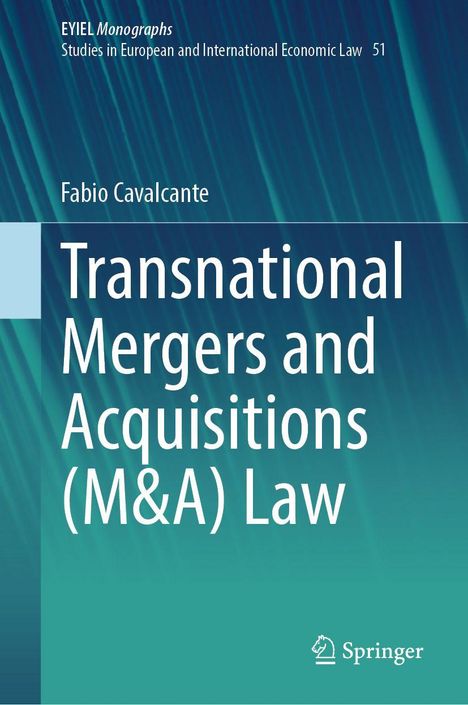
Fabio Cavalcante: Transnational Mergers and Acquisitions (M&A) Law, Gebunden
Transnational Mergers and Acquisitions (M&A) Law
Sie können den Titel schon jetzt bestellen. Versand an Sie erfolgt gleich nach Verfügbarkeit.
- Verlag:
- Springer Nature Switzerland AG, 10/2026
- Einband:
- Gebunden
- Sprache:
- Englisch
- ISBN-13:
- 9783032378545
- Artikelnummer:
- 12907144
- Umfang:
- 181 Seiten
- Erscheinungstermin:
- 14.10.2026
- Serie:
- European Yearbook of International Economic Law
- Hinweis
-
Achtung: Artikel ist nicht in deutscher Sprache!
Klappentext
This book offers a comprehensive analysis of how recurring contractual practices and arbitral awards in cross-border M&A transactions give rise to transnational M&A law. It begins by defining the scope of inquiry and establishing systems theory as the foundation for understanding the formation of transnational M&A law. The discussion then situates these developments within the broader context of economic globalization and the fragmentation of private law. The book highlights the limitations of uniform law instruments in addressing the complexity of cross-border M&A transactions and emphasizes the strategic use of private governance to manage uncertainty, particularly given the natural incompleteness of M&A agreements.
The analysis then identifies the three pillars that support the emergence of transnational M&A law: the form shaped by the dominance of English and US/UK legal terminology; the repetition of clauses that reinforce legal memory; and the adaptation of contractual structures driven by M&A global lawyering and the declining relevance of traditional legal families.
Building on this foundation, the book explores the substantive components of crossborder M&A agreements, showing that the purchase price functions as the cornerstone of every M&A deal. It analyzes how valuation and due diligence influence risk allocation, and examines the modular legal structures that recur across M&A deals.
The final chapter presents international commercial arbitration as the most suitable mechanism for resolving crossborder M&A conflicts. Arbitration is well suited to this because it keeps outcomes coherent and reinforces the legal structures the parties themselves agreed on. The conclusion connects the preceding chapters and offers direction for future research on transnational M&A law.