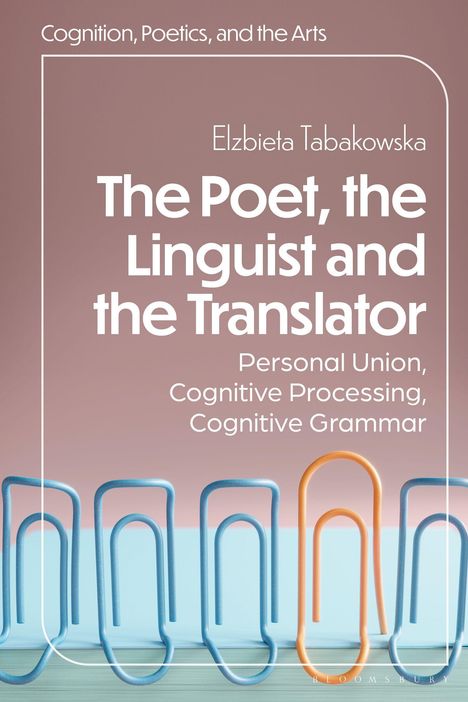
Elzbieta Tabakowska: The Poet, the Linguist and the Translator, Gebunden
The Poet, the Linguist and the Translator
- Personal Union, Cognitive Processing, Cognitive Grammar
Lassen Sie sich über unseren eCourier benachrichtigen, sobald das Produkt bestellt werden kann.
- Herausgeber:
- Alexander Bergs, Margaret H Freeman, Peter Schneck
- Verlag:
- Bloomsbury Academic, 05/2027
- Einband:
- Gebunden
- Sprache:
- Englisch
- ISBN-13:
- 9798765157886
- Umfang:
- 224 Seiten
- Gewicht:
- 503 g
- Maße:
- 229 x 152 mm
- Stärke:
- 28 mm
- Erscheinungstermin:
- 13.5.2027
- Hinweis
-
Achtung: Artikel ist nicht in deutscher Sprache!
Ähnliche Artikel


Klappentext
Shows that principles of cognitive linguistics can be applied to poetry writing, interpretation, and translation, as the author demonstrates by interpreting her own poems and translating them from Polish to English, both with the perspective of a cognitive linguist.
Elzbieta Tabakowska is The Poet, the Linguist and the Translator : She argues that cognitive linguistics are the semantic backbone and structural principle of her own poetry, then she uses these concepts as the basis for her own interpretation and translation of a number of her poems. She shows cognitive linguistics to be a toolbox that provides instruments to explain the writing process, as well as the reading and translation of the production of literary creation.
Based in cognitive theory of natural language and grammar but avoiding excessive technicality, this study presents rudiments of linguistic cognitivism from three different points of view: by considering a poem as instantiation of a schematic image, by interpreting the meaning of the poem in terms of Cognitive Grammar, and by its interlingual Polish (into English) self-translation, with all three processes seen as cognitive mental activities.
In addition to its contribution to a cognitive understanding of poetic creativity for poets, The Poet, the Linguist and the Translator is intended for literary scholars interested in the potential of language seen as raw material of poetry, for linguists interested in applications of their field to interpretation of poetry, as well as for scholars specializing in translation studies and to translators practicing interlingual translation.