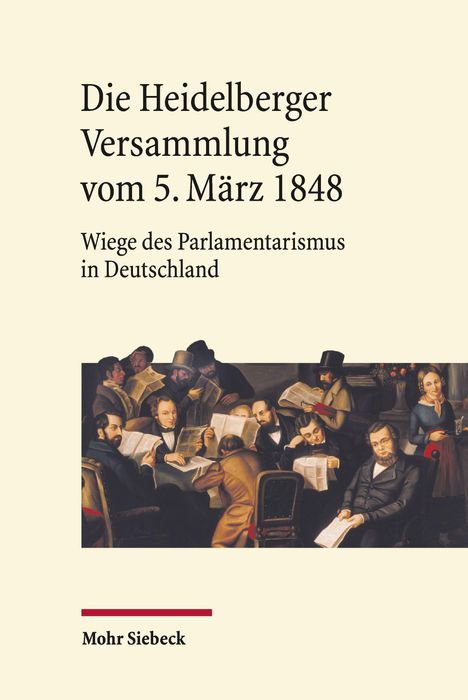
Die Heidelberger Versammlung vom 5. März 1848, Gebunden
Die Heidelberger Versammlung vom 5. März 1848
- Wiege des Parlamentarismus in Deutschland
Sie können den Titel schon jetzt bestellen. Versand an Sie erfolgt gleich nach Verfügbarkeit.
- Herausgeber:
- Stephan Harbarth, Frieder Hepp, Peter Hommelhoff, Paul Kirchhof, Bernd Schneidmüller
- Verlag:
- Mohr Siebeck GmbH & Co. K, 09/2026
- Einband:
- Gebunden
- Sprache:
- Deutsch
- ISBN-13:
- 9783162005656
- Artikelnummer:
- 12800917
- Umfang:
- 204 Seiten
- Nummer der Auflage:
- 26001
- Ausgabe:
- 1. Auflage
- Erscheinungstermin:
- 30.9.2026
Klappentext
The Heidelberg Assembly, which convened on March 5, 1848, at the inn Badischer Hof , paved the way for the establishment of a national representation in Germany. Triggered by the February Revolution of 1848, in which the French monarchy was finally overthrown, revolutionary unrest spread across parts of Europe in March 1848. The participants of the Heidelberg Assembly, however, firmly advocated a parliamentary path within the German Confederation, a course that was realized only a few weeks later through the establishment of the Frankfurt Parliament in St. Paul's Church.
Fifty-one men, most of them members of the South German estates assemblies, unanimously signed a declaration pursuing the following aims: no German interference in the affairs of neighboring countries; no alliance with Russia; the swift establishment of a national representation elected according to population size and thus truly representative, serving as a bulwark for the "German fatherland and the thrones"; and acceptance of the particular characteristics and self-government of the individual states. To implement this parliamentary path, seven men were appointed to prepare the establishment of the national representation. The later failure of parliamentarianism in Germany and the triumph of monarchical repression are reflected in several biographies of the 51 participants.
The essays in this volume acknowledge the significance of the Heidelberg Assembly as the cradle of parliamentarianism in Germany from the perspectives of history, legal studies, and political science. The book also reproduces key source documents as well as short biographies of all participants in the Heidelberg Assembly. The volume is richly illustrated with numerous historical images from archives, libraries, and museums.
Biografie (Peter Hommelhoff)
Peter Hommelhoff is Max Planck Research Group Head at MPQ in Garching, Germany, since 2008. After his physics studies at Technical University of Berlin and the Swiss Federal Institute of Technology (ETH) in Zurich, which conferred the diploma to him, he obtained his PhD from Ludwig Maximilian University of Munich working in T. W. Hänsch's atom chip group. Together with M. Kasevich at Stanford, as a Lynen-Fellow of the Humboldt Foundation and later Trimble Fellow, he started the field of ultrafast electron emission from nanometric tips, which led to attosecond science with metal nanostructures.Biografie (Paul Kirchhof)
Prof. Dr. Dr. h.c. mult. Paul Kirchhof, geboren 1943, war von 1987 - 1999 Bundesverfassungsrichter und Professor für Öffentliches Recht an der Universität Heidelberg. Bekannt geworden durch seinen Entwurf für ein einfaches, luzides Steuerrecht. 2005 erhält Paul Kirchhof den Jacob-Grimm-Preis Deutsche Sprache für seine Verdienste um die Sprache des Rechts und das deutsche Sprachenrecht.§Professor Paul Kirchhof ist Direktor des Instituts für Finanz- und Steuerrecht an der Ruprecht-Karls-Universität Heidelberg und Leiter der Forschungsstelle Bundesgesetzbuch.Biografie (Bernd Schneidmüller)
Bernd Schneidmüller ist Professor für Mittelalterliche Geschichte an der Ruprecht-Karls-Universität HeidelbergAnmerkungen:
Bitte beachten Sie, dass auch wir der Preisbindung unterliegen und kurzfristige Preiserhöhungen oder -senkungen an Sie weitergeben müssen.