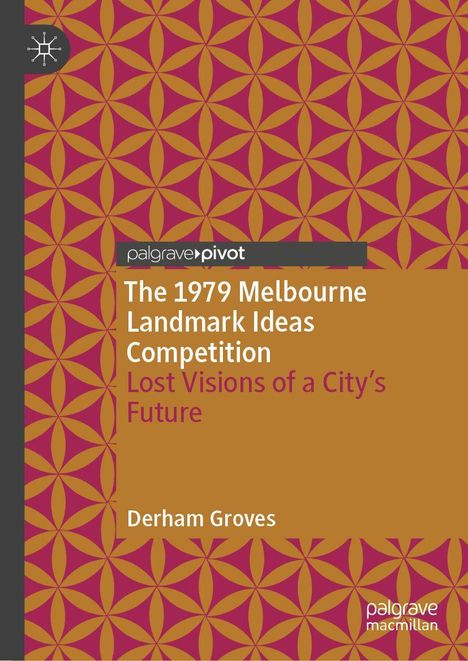
Derham Groves: The 1979 Melbourne Landmark Ideas Competition, Gebunden
The 1979 Melbourne Landmark Ideas Competition
- Lost Visions of a City's Future
Sie können den Titel schon jetzt bestellen. Versand an Sie erfolgt gleich nach Verfügbarkeit.
- Verlag:
- Springer Nature Switzerland AG, 10/2026
- Einband:
- Gebunden
- Sprache:
- Englisch
- ISBN-13:
- 9783032315359
- Artikelnummer:
- 12907033
- Umfang:
- 185 Seiten
- Erscheinungstermin:
- 5.10.2026
- Hinweis
-
Achtung: Artikel ist nicht in deutscher Sprache!
Klappentext
In 1979, the Victorian Government asked a deceptively simple question: What should Melbourne's landmark be? The Melbourne Landmark Ideas Competition invited anyone---architects, artists, engineers, dreamers, and amateurs---to imagine a new symbol for the city on the neglected Jolimont rail yards opposite Flinders Street Station. The response was overwhelming: 2, 300 proposals from around the world. They ranged from a giant Peach Melba and a building-sized chair to floating structures and megastructures, theme parks, monumental bridges, crystal pyramids, aquariums, laser beacons, and towers designed to rival the world's great icons. One scheme proposed a gigantic clock spanning the Jolimont rail yards. Another imagined a crocodile large enough to swallow the Melbourne Cricket Ground. Overwhelmed by the abundance, the judges famously failed to choose a single winner. Instead, they named forty-eight. Nothing was built.
Nearly half a century later, architectural historian Derham Groves revisits this extraordinary episode in Melbourne's history. Drawing on the original competition entries preserved in the Public Record Office Victoria, he reconstructs a moment when the city briefly opened its imagination to the world. Part detective story, part cultural history, and part cabinet of architectural curiosities, The 1979 Melbourne Landmark Ideas Competition: Lost Visions of a City's Future uncovers the forgotten schemes, the personalities behind them, and the debates they provoked. The result is a vivid portrait of Melbourne at a turning point---when modernist certainty was fading, postmodern playfulness was emerging, and the future of the city seemed up for grabs. The competition never produced a landmark, but it left behind something more revealing: a dazzling record of how people once imagined Melbourne's future---and how different that future might have been.