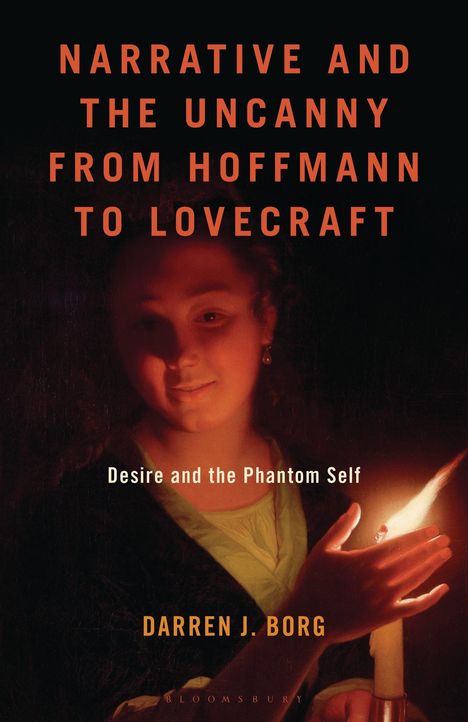
Darren J Borg: Narrative and the Uncanny from Hoffmann to Lovecraft, Gebunden
Narrative and the Uncanny from Hoffmann to Lovecraft
- Desire and the Phantom Self
Sie können den Titel schon jetzt bestellen. Versand an Sie erfolgt gleich nach Verfügbarkeit.
- Verlag:
- Bloomsbury Academic, 12/2026
- Einband:
- Gebunden
- Sprache:
- Englisch
- ISBN-13:
- 9798216380009
- Artikelnummer:
- 12709062
- Umfang:
- 256 Seiten
- Gewicht:
- 454 g
- Maße:
- 229 x 152 mm
- Stärke:
- 25 mm
- Erscheinungstermin:
- 10.12.2026
- Hinweis
-
Achtung: Artikel ist nicht in deutscher Sprache!
Klappentext
Starting with the conflict between desire and restraint in 19th-century fiction, this study locates the impulse to preserve ideological authority in subjectivity itself, identifying the uncanny as the consequence of a narrative's failure to suppress ideological antagonisms.
Theories of the uncanny have largely neglected its aesthetic power - the way it exposes the limits, exceptions, and impossibilities of the ideological field in which it occurs. This book shows how the form of a work contends with the forces of ideology that shape it. By examining the "specters" that haunt uncanny tales, both well-known and obscure, this study argues that the innovations of form that define 19th- and early-20th-century fiction - realism, impressionism, modernism, and the weird - represent efforts to control, contain, or exploit the power of the uncanny to destabilize ideological discourse.
Darren Borg develops an aesthetic of the uncanny that draws together elements of hauntology, psychoanalysis, aesthetics, and ideology. In terms that reconcile Freud's theory of the uncanny with Lacan's analysis of desire, he also puts forth an analysis of the uncanny in fiction that delineates the ideological implications of narrative technique. He examines how various 19th-century authors - among them Chamisso, Mary Shelley, James Hogg, Elizabeth Gaskell, Charles Dickens, Joseph Conrad, Sir Arthur Conan Doyle, and H. P. Lovecraft - approach the uncanny potential of their narratives.
Accordingly, Narrative and the Uncanny from Hoffmann to Lovecraftdemonstrates that the uncanny potential that resides within socializing narratives of the 19th century stimulates many major innovations of technique that define the era's fiction.