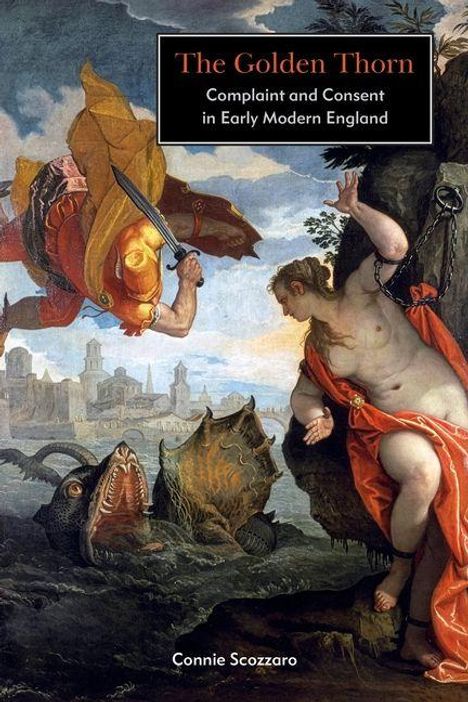
Connie Scozzaro: The Golden Thorn, Kartoniert / Broschiert
The Golden Thorn
- Complaint and Consent in Early Modern England
Sie können den Titel schon jetzt bestellen. Versand an Sie erfolgt gleich nach Verfügbarkeit.
- Verlag:
- Fordham University Press, 01/2027
- Einband:
- Kartoniert / Broschiert
- Sprache:
- Englisch
- ISBN-13:
- 9781531515089
- Artikelnummer:
- 12661313
- Umfang:
- 176 Seiten
- Erscheinungstermin:
- 5.1.2027
- Hinweis
-
Achtung: Artikel ist nicht in deutscher Sprache!
Weitere Ausgaben von The Golden Thorn |
Preis |
|---|---|
| Buch, Gebunden, Englisch | EUR 132,20* |
Klappentext
Examining different approaches to early modern lyric, The Golden Thorn argues that sadomasochistic bonds can be understood as dialogic despite asymmetries of power, and against the typical scholarly understanding of poetry as single-voiced or monologic. In these poetic dialogues, Scozzaro argues that even solo speakers can create and anticipate meaningful interlocutors in the search for consent, even in the unequal context of complaint.
Scozzaro responds to long-standing feminist definitions of the male voice in love complaint, whereby rhetorical force acts upon a silent female addressee, defining the genre as non-consensual and unilateral. Against this idea, Scozzaro shows how early modern love poetry might be enriched by recent discussions in liberal feminism, whose conversational turn presents consent as a dialogue that can have affirmative and negative qualities. Poetically speaking, Scozzaro challenges Bakhtin's claim that lyric is monologic, showing how his novelistic theories of dialogism can be productively applied to single-speaker verse.
Love complaint, Scozzaro shows, can conjure a secondary voice by strategies of address that elicit perverse consent through figures of pain and domination. Sometimes this consent is intrapersonal, where it appears as private debates with one's conscience; at other times it is interpersonal, focused on the outward persuasion of an imaginary other. Guided by Freud and Deleuze's theories of sadomasochism, the study explores the poetics of consent in lyric poems of Sidney, Shakespeare, Donne, and Carew. Ultimately, Scozzaro argues that the violence of these agreements does not mean they are not contractual but, rather, that they darkly revise the meaning of egalitarianism on which the modern sexual contract relies.