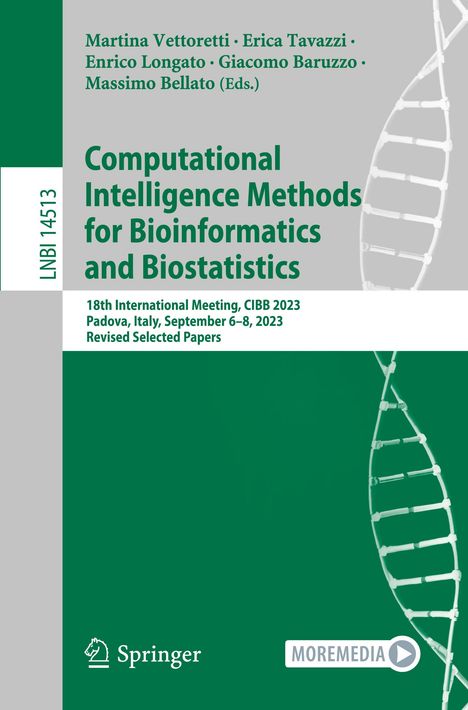
Computational Intelligence Methods for Bioinformatics and Biostatistics, Kartoniert / Broschiert
Computational Intelligence Methods for Bioinformatics and Biostatistics
- 18th International Meeting, CIBB 2023, Padova, Italy, September 6-8, 2023, Revised Selected Papers
(soweit verfügbar beim Lieferanten)
- Herausgeber:
- Martina Vettoretti, Erica Tavazzi, Enrico Longato, Giacomo Baruzzo, Massimo Bellato
- Verlag:
- Springer, 05/2025
- Einband:
- Kartoniert / Broschiert
- Sprache:
- Englisch
- ISBN-13:
- 9783031907135
- Artikelnummer:
- 12297775
- Umfang:
- 352 Seiten
- Gewicht:
- 534 g
- Maße:
- 235 x 155 mm
- Stärke:
- 20 mm
- Erscheinungstermin:
- 13.5.2025
- Serie:
- Lecture Notes in Computer Science - Band 14513
- Hinweis
-
Achtung: Artikel ist nicht in deutscher Sprache!
Klappentext
The book constitutes the refereed post-conference proceedings of the 18th International Meeting on Computational Intelligence Methods for Bioinformatics and Biostatistics, CIBB 2023, held in Padova, Italy, during September 6--8, 2023.
The 23 full papers presented in these proceedings were carefully reviewed and selected from 24 submissions. They focuses on topics such as machine learning in healthcare informatics and medical biology; machine learning explainability in medical imaging; prediction uncertainty in machine learning; advanced statistical and computational methodologies for single-cell omics data; present and future research in bioinformatics; distributed computing in bioinformatics and computational biology; and modelling and simulation methods for computational biology and systems medicine.