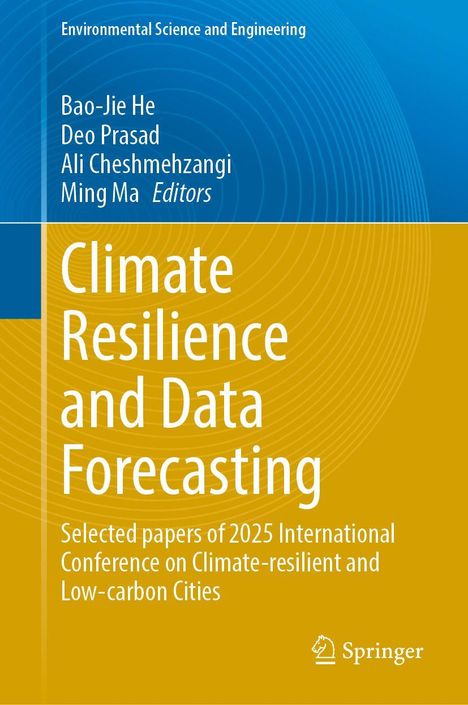
Climate Resilience and Data Forecasting, Gebunden
Climate Resilience and Data Forecasting
- Selected papers of 2025 International Conference on Climate-resilient and Low-carbon Cities
(soweit verfügbar beim Lieferanten)
- Herausgeber:
- Bao-Jie He, Deo Prasad, Ali Cheshmehzangi, Ming Ma
- Verlag:
- Springer, 01/2026
- Einband:
- Gebunden
- Sprache:
- Englisch
- ISBN-13:
- 9783032119094
- Artikelnummer:
- 12505719
- Umfang:
- 576 Seiten
- Gewicht:
- 1118 g
- Maße:
- 241 x 160 mm
- Stärke:
- 35 mm
- Erscheinungstermin:
- 25.1.2026
- Serie:
- Environmental Science and Engineering
- Hinweis
-
Achtung: Artikel ist nicht in deutscher Sprache!
Klappentext
Global warming and extreme weather events are becoming increasingly severe, and climate risks are particularly prominent. The current unsustainable development model of human society will exacerbate climate change and destroy ecosystems, and the impacts and risks caused by climate change will further threaten the already stressed human economic and natural ecosystems. These risks and impacts are becoming increasingly complex, compound, and consequential, and may interact with each other, further amplifying the resulting losses and damages.
Resilience is the ability of a social, economic, and environmental system to deal with catastrophic events, trends, or disturbances, and to maintain its essential functions, positioning, and structure while responding or reorganizing, and to maintain its ability to adapt, learn, and transform. The world urgently needs to take timely and strong actions to promote comprehensive and systematic transformation and adaptation, and to seek a path of climate - resilient development.
This book focuses on two major research directions on climate resilience. One is the enhancement of the climate resilience of urban ecosystems. The other is the application of artificial intelligence and big data. The first part starts with urban ecosystems by analyzing the performance and capacity of urban ecosystems under extreme weather and the increasingly severe climate change and providing measures and technical solutions related to urban climate resilience. The second part presents the integration of artificial intelligence into climate resilience and climate change prediction which enables people to better predict the changes in climate and choose better solutions to deal with and solve the problems. The intelligent systems also enable decision makers to better deliver early warning and adaptation functions. The potential readers of this book are engineers, scholars, and Ph. D in the field of environmental engineering and urban planning.