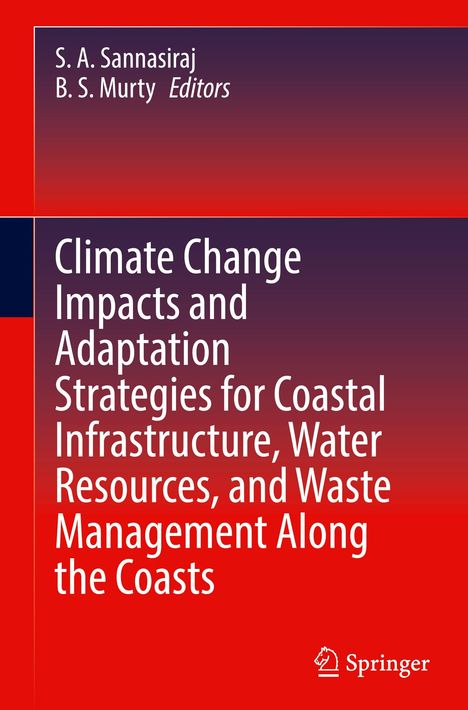
Climate Change Impacts and Adaptation Strategies for Coastal Infrastructure, Water Resources, and Waste..., Gebunden
Climate Change Impacts and Adaptation Strategies for Coastal Infrastructure, Water Resources, and Waste Management Along the Coasts
(soweit verfügbar beim Lieferanten)
- Herausgeber:
- S. A. Sannasiraj, B. S. Murty
- Verlag:
- Springer, 05/2026
- Einband:
- Gebunden
- Sprache:
- Englisch
- ISBN-13:
- 9789819583324
- Artikelnummer:
- 12773289
- Umfang:
- 284 Seiten
- Gewicht:
- 644 g
- Maße:
- 241 x 160 mm
- Stärke:
- 20 mm
- Erscheinungstermin:
- 19.5.2026
- Hinweis
-
Achtung: Artikel ist nicht in deutscher Sprache!
Klappentext
The book 'Climate change impacts and adaptation strategies for coastal infrastructure, water resources, and waste management along the coasts' offers a critical exploration of the profound challenges that climate change poses to Indian coastline districts. It focuses on reducing uncertainties in predicting coastal dynamics due to climate change impacts, specifically along India's coastlines.
Organized into nine individual chapters, this book covers key topics such as wave prediction with a deep understanding of wave dynamics, inundation due to storm surge and rainfall, climate change and coastal hazard vulnerability assessments, and adaptation strategies to reduce uncertainties for the existing coastal defense systems in an urban environment. The initial chapters focus on improving the efficiency of predictive models to address knowledge gaps, gradually moving to practical solutions such as promoting soft measures and enhancing local community engagement in adaptation planning. The book highlights key findings, including addeduncertainty in water availability, increased vulnerability due to overlooked socio-economic systems, the rigidity of urban infrastructure (like wastewater systems), and heightened risk from delayed cyclone landfalls. In addition to addressing these gaps, this book also exploresoptionssuch as soft, nature-based solutions and decentralized urban systems in densely populated and highly vulnerable populations in the local context.
By highlighting critical knowledge gaps, the volume offers comprehensive, research-backed approaches to effectively address uncertainty. Readers will gain the technical foundation for strategic coastal adaptation, resilient planning, and proactive disaster management, enabling them to implement low-impact, efficient solutions that secure the future of our coastal regions.