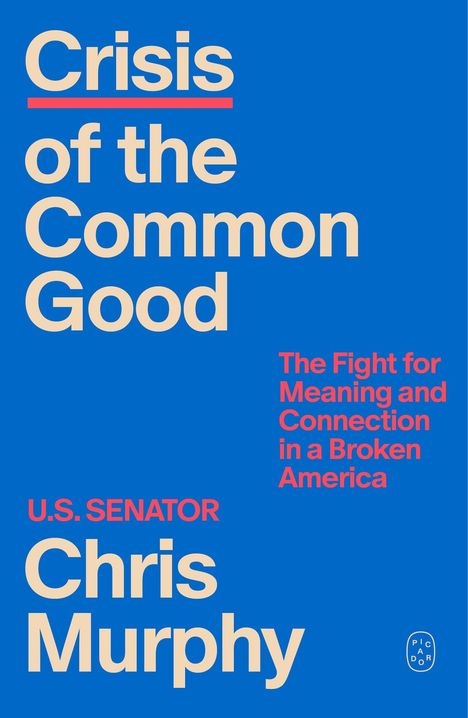
Chris Murphy: Crisis of the Common Good, Kartoniert / Broschiert
Crisis of the Common Good
- The Fight for Meaning and Connection in a Broken America
Lassen Sie sich über unseren eCourier benachrichtigen, sobald das Produkt bestellt werden kann.
- Verlag:
- Picador USA, 05/2027
- Einband:
- Kartoniert / Broschiert
- Sprache:
- Englisch
- ISBN-13:
- 9781250492517
- Umfang:
- 304 Seiten
- Gewicht:
- 454 g
- Maße:
- 210 x 137 mm
- Stärke:
- 25 mm
- Erscheinungstermin:
- 25.5.2027
- Hinweis
-
Achtung: Artikel ist nicht in deutscher Sprache!
Weitere Ausgaben von Crisis of the Common Good |
Preis |
|---|---|
| Buch, Gebunden, Englisch | EUR 27,91* |
Ähnliche Artikel


Klappentext
A New York TimesBestseller
A prominent senator assesses the destructive ideas that have seized the American spirit-and shows how the hidden alignments in our politics can free us from their hold.
Today, the United States is in a crisis, and it's not just a political one: over fifty years, the pursuit of profit has undermined virtue and individual character, while too many of us have become convinced that happiness results from acting as good consumers rather than as good citizens. New technologies are threatening essential human capabilities, like friendship, thinking, and creation. And a winner-takes-all mentality has given the rich and well-connected nearly uncontested control of our politics and corrupted our government. The result: Americans have lost the sense of daily purpose and connection that is vital to happiness and have become anxious, angry, and adrift. In this vacuum, Donald Trump, feeding off the emptiness and resentment, has come to power.
Senator Chris Murphy has been stepping forward to challenge the Trump administration's assaults on our democracy. But he also sees these assaults as a symptom of a deeper crisis: the abandonment of the common good as our country's organizing principle. In his unflinching new book, Murphy draws on history and political philosophy to expose how six different cults have seized hold of American life and paved the way to our current troubles: a cult of profit that punishes workers, a cult of globalism that weakens communities, a cult of technology that turns us against one another and poisons our young, a cult of consumption that undermines citizenship, a cult of credentialism that devalues those without college degrees, and a cult of corruption that threatens democracy.
Refusing despair, Murphy offers a new politics of the common good that is both deeply rooted in our past and a radical challenge to the status quo. It is also capable of drawing support from across the political spectrum: as Murphy shows, a majority of Americans-including many Trump voters-favor policies that confront these destructive cults by curbing corporate power, controlling predatory technology, enhancing face-to-face connection, expanding workers' control of their lives, and removing big money from our politics. The common good, Murphy shows, is no object of nostalgia; it is a vital principle ready to be claimed today.