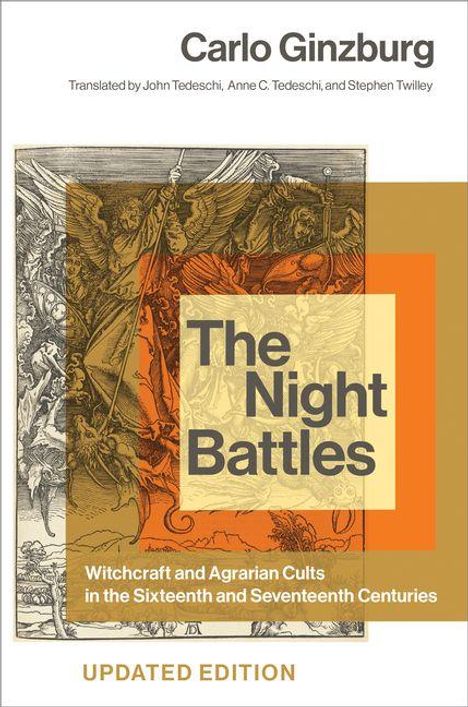
Carlo Ginzburg: The Night Battles, updated edition, Kartoniert / Broschiert
The Night Battles, updated edition
Sie können den Titel schon jetzt bestellen. Versand an Sie erfolgt gleich nach Verfügbarkeit.
- Übersetzung:
- John Tedeschi
- Verlag:
- Hopkins Fulfillment Service, 08/2026
- Einband:
- Kartoniert / Broschiert
- Sprache:
- Englisch
- ISBN-13:
- 9781421455570
- Artikelnummer:
- 12631766
- Umfang:
- 258 Seiten
- Nummer der Auflage:
- 26002
- Ausgabe:
- updated edition
- Gewicht:
- 368 g
- Maße:
- 235 x 156 mm
- Stärke:
- 17 mm
- Erscheinungstermin:
- 4.8.2026
- Hinweis
-
Achtung: Artikel ist nicht in deutscher Sprache!
Klappentext
A landmark of microhistory, The Night Battles remains one of the most daring and influential investigations of witchcraft and popular belief in early modern Europe. Through meticulous research in the inquisitorial archives of northern Italy, Carlo Ginzburg reconstructs the story of the benandanti-the "good walkers"-peasants of the Friuli region who claimed that, while their bodies slept, their spirits journeyed into the night to battle witches and warlocks in defense of their crops and communities. Armed with fennel stalks, these benandanti fought for fertility and abundance. To the inquisitors who interrogated them, however, such nocturnal visions could only signify diabolical witchcraft. Over decades of questioning and reinterpretation, a profound cultural clash unfolded, and the benandanti were gradually transformed from defenders of the harvest into supposed participants in the witches' sabbat. From this richly documented case, Ginzburg advances a bold hypothesis: that across Europe, elements of agrarian and ecstatic traditions were recast under pressure from ecclesiastical authorities into the stereotype of satanic conspiracy. The Friulian trials, exceptional in their detail, offered what he would later call an "exemplary case"-a fragment of testimony that illuminates broader historical processes. In a substantial new afterword, Ginzburg reflects on the role of chance discovery in archival research, the dialogue between history and anthropology, and the personal and intellectual forces that shaped his inquiry. Revisiting his own encounter with the voices of the accused, he offers a rare meditation on historical method, perspective, and the moral ambiguities of studying persecution.
Biografie (Carlo Ginzburg)
Carlo Ginzburg wurde 1939 als Sohn von Leone und Natalia Ginzburg in Turin geboren. Er lehrt Neuere Geschichte an der Universität von Bologna und der California State University in Los Angeles. Sein Werk, wovon besonders "Der Käse und die Würmer" ihm hohes Renomme unter den europäischen Historikern verschaffte, wurde in fünfzehn Sprachen übersetzt und mit mehreren Preisen ausgezeichnet, unter anderem mit dem Premio Salento, dem Premio Viareggio sowie dem Aby-M.-Warburg-Preis der Stadt Hamburg. Ginzburg ist Ehrenmitglied der amerikanischen Academy of Arts and Sciences.