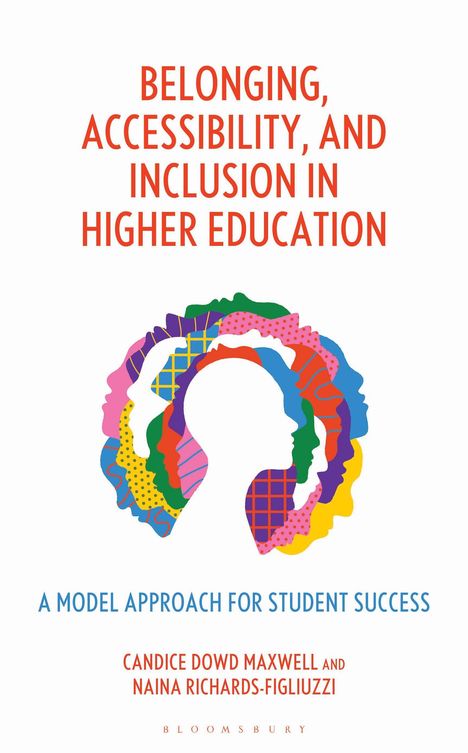
Candice Dowd Maxwell: Belonging, Accessibility, and Inclusion in Higher Education, Gebunden
Belonging, Accessibility, and Inclusion in Higher Education
- A Model Approach for Student Success
Lassen Sie sich über unseren eCourier benachrichtigen, sobald das Produkt bestellt werden kann.
- Verlag:
- Bloomsbury Academic, 06/2027
- Einband:
- Gebunden
- Sprache:
- Englisch
- ISBN-13:
- 9798216467014
- Umfang:
- 304 Seiten
- Gewicht:
- 454 g
- Maße:
- 229 x 152 mm
- Stärke:
- 25 mm
- Erscheinungstermin:
- 10.6.2027
- Hinweis
-
Achtung: Artikel ist nicht in deutscher Sprache!
Ähnliche Artikel


Klappentext
This book offers a fresh approach to ensuring that college classrooms and student services are equitable, accessible, and grounded in belonging and inclusion. Through practical strategies, real-world case stories, and interactive activities, it addresses today's most pressing challenges in teaching and student support. Designed in a workbook style, it invites readers to engage directly with the content, reflect on their own practices, and implement meaningful changes to strengthen student success.
Offering a new model that integrates belonging, accessibility, and inclusion as a comprehensive approach, it moves beyond abstract principles to present concrete strategies, reflective exercises, and case studies that enable educators and student support staff to apply ideas directly to their work. By integrating practical strategies, the book provides targeted guidance on removing barriers, applying best practices, and supporting all students, especially those with diverse needs.
This book approaches diversity in its broadest sense-acknowledging race, ethnicity, gender, and disability alongside socioeconomic status, first-generation status, learning differences, age, culture, and life experiences. It recognizes that students' identities and circumstances often intersect, shaping their educational experiences. Rather than focusing solely on labels, the book emphasizes how educators and staff can respond to students' diverse needs in practical ways that ensure access, opportunity, and a sense of belonging. It equips readers not only to recognize diversity in their classrooms and other campus spaces but also to design practices that value, include, and uplift all students. In doing so, it reframes conversations around equity in higher education, centering them on what matters most: student success, meaningful learning, and the creation of environments where every student can thrive.