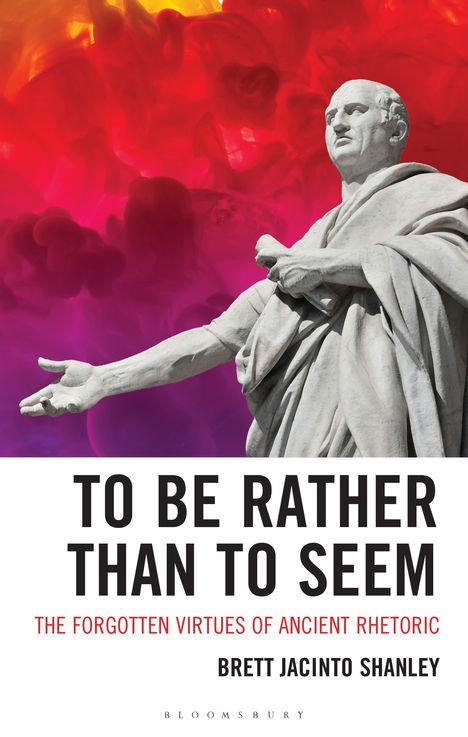
Brett Jacinto Shanley: To Be Rather than to Seem, Gebunden
To Be Rather than to Seem
- The Forgotten Virtues of Ancient Rhetoric
Sie können den Titel schon jetzt bestellen. Versand an Sie erfolgt gleich nach Verfügbarkeit.
- Verlag:
- Bloomsbury Publishing plc, 02/2027
- Einband:
- Gebunden
- Sprache:
- Englisch
- ISBN-13:
- 9781666948950
- Artikelnummer:
- 12796477
- Umfang:
- 288 Seiten
- Gewicht:
- 391 g
- Maße:
- 229 x 153 mm
- Stärke:
- 15 mm
- Erscheinungstermin:
- 4.2.2027
- Hinweis
-
Achtung: Artikel ist nicht in deutscher Sprache!
Klappentext
In this book, Brett Jacinto Shanley covers the modern considerations of ancient rhetorical ethics, a popularly forgotten ethical-rhetorical theory, with particular attention given to the work of Aristotle, Cicero, and Quintilian.
Composition writing is a ubiquitous subject at contemporary American universities, serving as the modern descendent to arguably the most celebrated ancient academic discipline, rhetoric. There are however massive differences between past and present practice in terms of its overall philosophy. What today is framed as skill development was once highly loaded with questions of morality. Being a good speaker or writer was not enough. It was thought one ought to do good with those powers.
This book actively and explicitly uncovers elements of ancient rhetorical ethics including rhetoric, ethics, virtue, morality, and classical studies - all situated within an intentionally holistic framework to better elucidate their interconnection. Beginning with Plato's paradoxical position as the foundational figure of ancient ethical-rhetorical theory - and as a philosopher who vehemently distrusted rhetoric - the book then turns to the sophists, the professional teachers whose amoral rhetorical model Plato so opposed, offering a balanced account of their practice and their own (minimal but not non-existent) ethical self-understanding. Jacinto Shanley then looks to Isocrates, Aristotle, Cicero, and Quintilian to fully situate the culmination of the ancient ethical-rhetorical tradition. There is a radicalism to these ancient theories applied to modern classrooms with modern, progressive values. Although literally the musings of long-dead aristocratic white men, this book argues ancient rhetorical ethics has far more overlap with modern transformative education models and liberatory pedagogy that traditionally recognized.