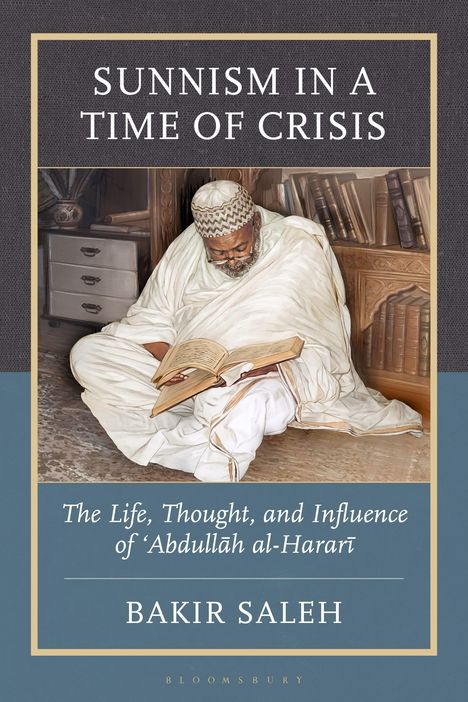
Bakir Saleh: Sunnism in a Time of Crisis, Gebunden
Sunnism in a Time of Crisis
- The Life, Thought, and Influence of Abdullah al-Harari
Sie können den Titel schon jetzt bestellen. Versand an Sie erfolgt gleich nach Verfügbarkeit.
- Verlag:
- Bloomsbury Publishing plc, 02/2027
- Einband:
- Gebunden
- Sprache:
- Englisch
- ISBN-13:
- 9798216460602
- Artikelnummer:
- 12809064
- Umfang:
- 160 Seiten
- Gewicht:
- 225 g
- Maße:
- 229 x 153 mm
- Stärke:
- 9 mm
- Erscheinungstermin:
- 18.2.2027
- Hinweis
-
Achtung: Artikel ist nicht in deutscher Sprache!
Klappentext
The first full-length academic study of 'Abdullah al-Harari (d. 2008), a major yet understudied Sunni scholar whose life and thought illuminate the theological and institutional struggles that have influenced modern Sunnism.
While much scholarly attention has been devoted to various religio-political movements such as the Ikhwan and Hizb al-Tahrir, no comparable analysis has examined al-Harari's project to defend and revitalize the classical Sunni tradition rooted in Ash'ari-Maturidi theology, the four legal schools, and Sufi ethics.
Drawing on unpublished Arabic sources, oral testimonies, and doctrinal writings, Bakir Saleh reconstructs al-Harari's intellectual formation in Harar, Ethiopia, his public debates with proponents of literalism, his exile and travels, and his eventual stewardship over of the Association of Islamic Charitable Projects (AICP) in Lebanon. Through this biographical and historical lens, the book situates al-Harari's defence of tanzih (divine transcendence) and use of ta' wil (interpretive hermeneutics) within the larger Ash?ari commitment to theological employment of both reason and revelation.
The study also examines al-Harari's polemics against contemporary ideologues such as Sayyid Qutb and movements like Hizb al-Tahrir, highlighting how his interventions sought to counter both literalism and indiscriminate takfir (excommunication), which he viewed as destabilizing Sunni unity. By analysing these debates within their socio-political and intellectual contexts, Saleh demonstrates how al-Harari's teachings aimed to restore coherence to a modern-day fractured identity facing Sunnis and to safeguard tradition against extremism and ideological manipulation.
In tracing al-Harari's global institutional legacy through the AICP's educational and outreach networks in the Middle East, North America, and Europe, the book reveals how a contested yet influential scholar sought to articulate a modern Sunni orthodoxy that could withstand fragmentation while remaining faithful to its classical foundations.